Twenty Doors Where There Were Fifty: How Washington’s New African Visa Map Sends Kenyans on the Road
A directive from Secretary of State Marco Rubio cuts US visa processing in Africa from nearly fifty embassies to twenty hubs. Nairobi survives — but the diaspora’s regional safety net does not.

Consider the position of a Kenyan project officer working for a regional NGO in Bujumbura, with a US student visa interview booked for late summer and a graduate place waiting at a university in Minnesota. Her appointment slip from the embassy is, technically, still valid. After this week's flurry of WhatsApp messages and an Associated Press headline that travelled faster than any State Department announcement, she has begun to suspect that the slip will soon mean nothing at all. Bujumbura is not on the new list of twenty.
That list is the operative document in a quietly drastic reorganisation of how Washington reaches the African continent. According to an internal State Department memo seen by the Associated Press and confirmed by three US officials, Secretary of State Marco Rubio approved a directive last week that will reduce US visa processing in Africa from nearly fifty embassies and consulates down to twenty designated hubs. Africanews and Euronews carried the same details on Tuesday, with the change expected to take effect during June. For Kenyans, the headline reads two ways at once: Nairobi keeps its full visa window — but the regional network many in the diaspora have relied on for years is being dismantled.
The Memo That Reshapes a Continent
The twenty cities cleared to process all categories of US visas are familiar capitals and a few strategically chosen smaller posts: Abidjan, Accra, Addis Ababa, Cape Town, Dakar, Dar es Salaam, Djibouti, Johannesburg, Kampala, Kigali, Kinshasa, Lagos, Lomé, Luanda, Malabo, Monrovia, Nairobi, Port Louis, Praia and Yaoundé. Everything outside that ring is being downgraded. Consular sections in non-hub countries will continue to assist US citizens with passport renewals, manage emergency cases and process the small number of diplomatic visas that fall under their remit. They will not, however, see a routine student, tourist, business or family-immigrant applicant.
In practical terms, that change strips visa services from roughly thirty US posts on the continent. North Africa loses Cairo, Rabat, Tunis and Algiers as visa offices. The Sahel and the Horn lose Khartoum, Asmara, Mogadishu and N'Djamena. Southern Africa loses Maputo, Harare, Lusaka, Gaborone, Mbabane and Maseru. Madagascar's mission in Antananarivo is reportedly also affected. The State Department has not yet confirmed the cuts publicly on a country-by-country basis, and the AP memo notes that Washington intends to manage the announcements with affected host governments before making the new map official.
Why Nairobi Stays — And What That Means for Kenyans at Home
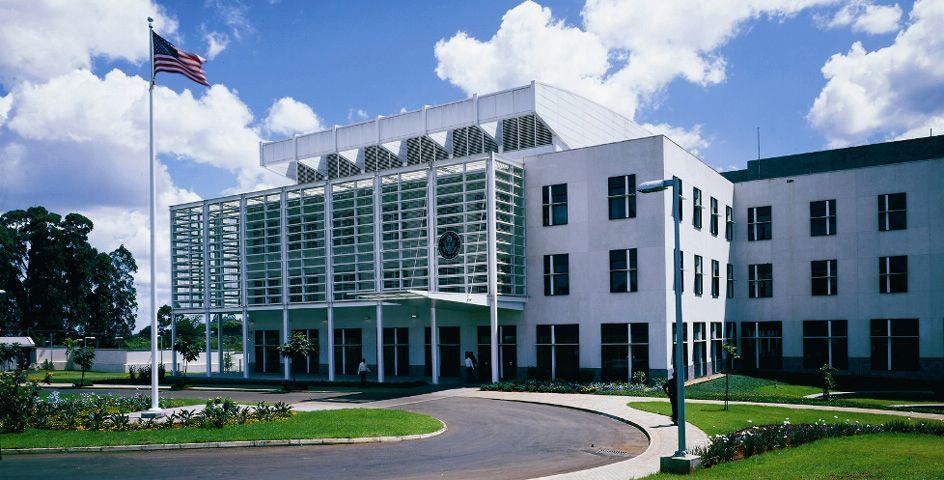
For applicants based in Kenya, the immediate change is close to none. The US Embassy in Nairobi has been one of the busiest visa-issuing posts in East Africa for years and is already designated as the regional immigrant-visa centre for Eritrea, Somalia and South Sudan. Under the new architecture, those designations make it almost unthinkable that Nairobi could lose hub status in this round. A Kenyan undergraduate applying for an F-1, a nurse heading to interview for an EB-3, a family member chasing an IR-5 will still walk through the same gate on United Nations Avenue.
What is changing for Kenya is more subtle. With several neighbouring posts losing visa services, the flow into Nairobi is set to grow. Eritrean and Somali applicants were already routed through Kenya; now South Sudanese applicants based in Juba will likely follow suit, and a portion of the overflow from Bujumbura, Antananarivo and other downgraded posts may also land at Nairobi's door. Immigration lawyers contacted by regional outlets have spent the week warning clients that interview slots will tighten, and that the wait between booking and a non-immigrant interview — already running into many months — is unlikely to shorten.
The Hidden Cost: Kenyans Living and Working Elsewhere in Africa
The Kenyan diaspora is not only the community in Boston, Birmingham and Brisbane. Tens of thousands of Kenyans live and work in other African countries, often as professionals in regional offices for the United Nations, the African Development Bank, mining firms, churches and NGOs. They send children to school in Cairo, look after parents in Maputo, run consultancies in Harare and study Arabic in Tunis. For all of them, the closest US visa window has just moved hundreds — or thousands — of kilometres further away.
A Kenyan teacher in Cairo who needs a B1/B2 visa to attend a family graduation in Houston now faces a flight to Addis Ababa or back to Nairobi rather than a metro ride across the city. A Kenyan radiographer in Mozambique applying for an EB-3 employment visa must add a trip to Johannesburg to her invoice. None of this is impossible. All of it adds cost, time and the kind of paperwork — yellow-fever cards, second visas, hotel bookings — that quietly raises the bar for who can actually pursue the United States as an option.
The Pattern Behind the Cuts
The Africa consolidation does not sit in isolation. In January, the State Department suspended visa processing for citizens of 75 countries, a list that included several African states. Last August, the administration revived a 15,000-dollar visa bond programme for travellers from high-risk countries and announced a review of 55 million existing visa holders for potential violations. Officials briefed on the new Africa plan told the Associated Press that visa overstays remain the central diagnosis Washington has settled on for unauthorised migration, and that concentrating consular work into fewer, larger posts is meant to make the screening of applicants more uniform.
That framing matters because it signals where the policy is heading. The hubs are being described as places where vetting can be standardised, fraud teams can be larger and security clearances can move through a single channel. Whether that translates into faster appointments, longer ones or simply fewer approvals is the question every African applicant — and every immigration attorney serving the diaspora — is now trying to answer.
What the State Department Says, and What It Does Not
In its public response, the State Department has confirmed only that it regularly reviews overseas operations to align resources with US priorities, and that any restructuring will preserve the integrity of security screening. There has been no public list of the embassies losing visa services, no schedule for the cutover and no formal guidance on how applicants who already hold appointments at downgraded posts should proceed. For now, that uncertainty is the most universally African experience of the change.
For the project officer in Bujumbura, the practical question is simple. If the interview slot is voided, she will travel to Kampala or fly to Nairobi, pay for another set of flights and another night in a hotel, and hope the Minnesota deadline holds. She has done the budgeting on a notebook page. The Kenyan diaspora's bigger account is harder to settle: the regional network that quietly underwrote a generation of African mobility to the United States is, with one approved memo, less than half the size it was last week.