The Purple Ribbon March: Kenya's Lawyers Down Tools for Two Advocates Found Dead
After advocates Esther Keige and Edward Kariuki were found dead within a fortnight, the Law Society of Kenya has called a nationwide march for Friday — and a wary diaspora is watching.

On Friday morning, the lawyers will not go to court. They will gather instead on the steps of the Milimani Law Courts in Nairobi, in the dark suits they normally wear to argue cases, with a small square of purple ribbon pinned where a flower might go. From nine o'clock they will walk — not to a bench, but to the headquarters of the National Police Service, carrying a petition and two names they refuse to let the country forget.
The names are Esther Wairimu Keige and Edward Muthee Kariuki. Both were advocates. Both are dead. And the Law Society of Kenya, which represents the country's lawyers, has decided that the ordinary machinery of grief and press statements is not enough this time.
Two Deaths, a Fortnight Apart
The facts, as they have emerged, are spare and disturbing. Edward Kariuki's body was found on 5 July outside his residence in Athi River, the industrial satellite town southeast of Nairobi. Esther Keige, who served as Director of Legal Services at the Kenya Forest Service, had been missing for weeks before her body was recovered. Two members of the same small profession, killed within a narrow window, their cases now spoken of in the same breath.
For the Law Society, the pattern is the point. A single killing is a tragedy for a family. Two, of advocates, in a fortnight, reads to the profession as a warning — that practising law in Kenya, particularly law that touches money and land, has become dangerous work.
What the Society Is Demanding
The march is not only a memorial. It carries a list of demands aimed squarely at the state. LSK has called for the immediate formation of a multi-agency investigative team, including the Directorate of Criminal Investigations, to examine both murders and to establish whether they are connected — and whether they trace back to wider criminal networks rather than isolated attackers.
The second demand is more pointed, and it is the one that has drawn the sharpest attention. The Society wants a forensic audit of disputed land transactions handled by the Kenya Forest Service's legal department over the past year, to determine whether Keige's death was linked to her official duties. In a country where land is the currency of both wealth and violence, the suggestion is unmistakable: that a lawyer may have been killed for what she knew, or what she was refusing to sign.
Purple, and the Choreography of Protest
There is a deliberate discipline to how the Society has framed Friday. Participants have been asked to wear formal attire and purple ribbons, a colour chosen for unity and remembrance rather than the reds and greens of partisan politics. The Nairobi contingent will move from Milimani to the police headquarters to hand over its petition to the Inspector-General. Parallel marches are planned in LSK's regional branches across the country, led by local officials.
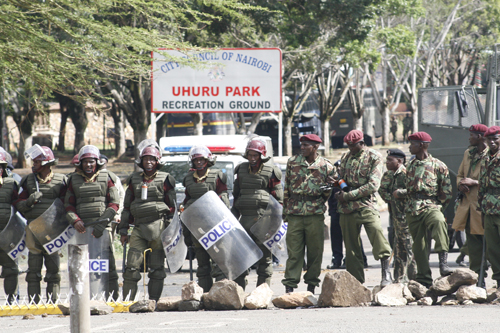
This is protest in the register lawyers know best — orderly, documented, addressed to a named authority with a specific ask. It is a long way from the barricades and tear gas that defined Nairobi's streets during last year's youth-led protests. But the underlying grievance rhymes: a citizenry, and now a profession, demanding that the state account for lives lost and answers withheld.
Why the Diaspora Is Watching
To a Kenyan in Atlanta or Manchester scrolling through the news on Friday, a lawyers' march might seem a domestic matter, far from the concerns of a life built abroad. It is not. The diaspora's relationship with home runs through exactly the institutions this march is about.
Consider what Kenyans abroad actually do with their money and their trust. They buy land. They build houses they may not live in for a decade. They send remittances into a system that depends, at every step, on contracts being honoured and courts functioning. The single greatest fear of the diaspora investor is not a bad exchange rate; it is the story, repeated in every WhatsApp group, of the plot bought and then grabbed, the title deed that turned out to be worthless, the relative who sold the same land twice. A functioning legal profession is the thin membrane that stands between a diaspora's savings and that nightmare.
When advocates who handle land matters start turning up dead, that membrane looks frighteningly thin. The march at Milimani is, among other things, a signal to everyone watching from abroad about whether the rule of law they are betting their futures on can protect the very people who administer it.
A Profession Testing Its Own Weight
The Law Society has done this before — used the collective withdrawal of legal labour and the spectacle of robed professionals in the street to press the government. Whether it works this time will depend on what the multi-agency team, if it is formed, actually finds, and whether the demanded audit of forest-service land deals ever sees daylight.
For now, the profession is doing the one thing it can do together: showing up, in suits and purple ribbons, to insist that two of its members not become another set of unsolved files. The petition handed over on Friday will ask for investigators, timelines and transparency. The subtext, legible to Kenyans at home and abroad alike, is simpler. It asks whether a country can call itself governed by law when the people who practise it are being buried.
The answer will not come on Friday. But the march is how the question gets asked loudly enough that the state must, eventually, reply.