The Oath That Can Be Unsaid: How America's Largest Denaturalization Drive Reaches the Kenyans Who Thought They Were Home
Washington is reviewing old naturalization files at a scale never tried before. For Kenyan-Americans who took the oath years ago, the paperwork suddenly matters again.
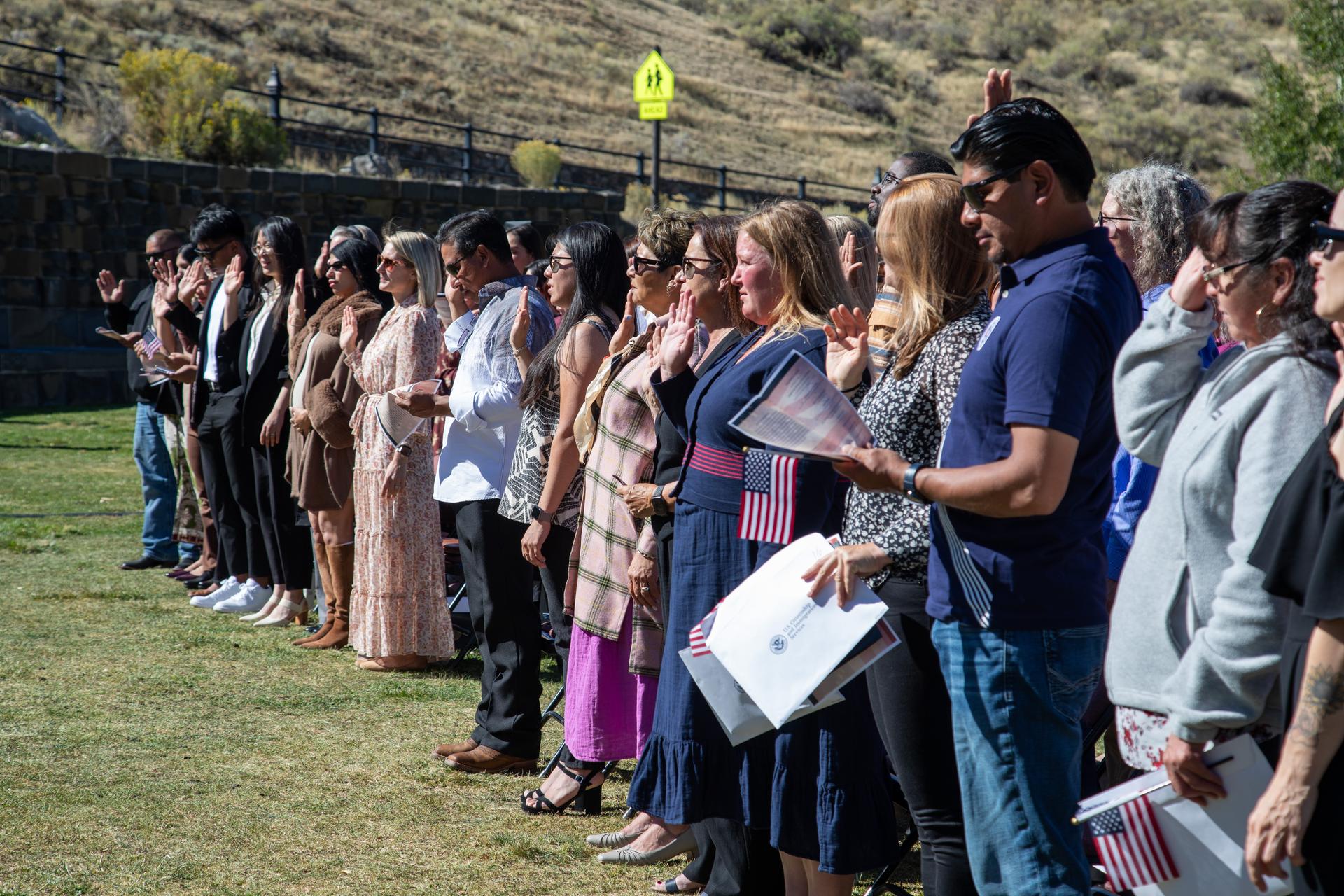
For most Kenyan-Americans, the certificate sits in a drawer. It is the document you produced once to get a passport, perhaps photographed for a job, and then filed away with the assumption that it had settled the question of belonging for good. The oath was taken, the photograph snapped, the small flag waved in a county courthouse. After that, citizenship was supposed to be the one part of an immigrant's American life that no longer required watching.
That assumption is what shifted on Monday. The United States Department of Justice announced what officials described as the largest effort in the country's history to strip naturalized Americans of their citizenship, a campaign that reaches back into files many people believed were closed. For the roughly hundreds of thousands of Kenyan-born residents who have built lives in the United States — and the many among them who became citizens — the news landed less as abstract policy than as a question about their own paperwork.
A Procedure Pulled From the Margins
Denaturalization is not new. The legal mechanism for revoking citizenship has existed for more than a century, reserved historically for extreme cases: war criminals who lied about their pasts, or people who obtained citizenship under stolen identities. What is new is the scale. According to court filings and Justice Department guidance reported by US outlets, the government wants its citizenship agency to refer between 100 and 200 cases a month to federal prosecutors during the current fiscal year.
To grasp how large a shift that is, consider the historical baseline. Between 1990 and 2017, the United States filed just over 300 denaturalization cases in total — an average of roughly eleven a year. The new directive, if carried out, could push the annual figure toward two thousand or more. An initial wave of cases has already been identified, with hundreds of foreign-born Americans named for the first round of litigation.
The Justice Department has framed the operation as a matter of integrity rather than identity. Officials say the campaign targets people who concealed material facts during naturalization — undisclosed criminal histories, false identities, sham marriages, or financial fraud such as pandemic-loan and health-program schemes. Several agencies, including the Department of Homeland Security and the Federal Bureau of Investigation, are involved in reviewing past files. The department has stressed that cases will be judged individually and that the effort is not directed at any nationality or ethnic group.
What the Numbers Actually Say
The reassurance about scope sits uneasily beside the arithmetic. A government that filed eleven cases a year is now building the capacity to file that many in a single afternoon. Even if the vast majority of naturalized citizens have nothing in their records to fear, a twentyfold expansion changes the texture of how citizenship feels. It becomes, in the words of immigration lawyers, "less of a final destination and more of a status that can be reopened."
The legal threshold remains demanding. To revoke citizenship, the government must prove fraud or illegality by evidence that is, in the courts' phrasing, clear, convincing, and unequivocal. That is a high bar, far above the standard used in ordinary civil disputes, and defendants are entitled to lawyers and to contest the case. In civil denaturalization proceedings, however, the person facing the loss of citizenship is not guaranteed a government-funded attorney — a gap that worries advocates most, because it means the outcome can hinge on whether a family can afford competent counsel.
If a court orders denaturalization, the person does not become stateless overnight. They typically revert to lawful permanent residence — the green-card status they held before the oath. But that downgrade carries a heavy consequence: permanent residents, unlike citizens, can be placed in deportation proceedings. The protection that citizenship was supposed to make permanent is, in these cases, peeled back.
Why Kenyan-Americans Are Paying Attention
For the Kenyan community, the story carries a particular weight because of how recently many of its members crossed the threshold into citizenship. Kenyans are among the larger African-born populations in the United States, concentrated in metropolitan areas such as Dallas, the Washington–Baltimore corridor, Atlanta, Boston, and the Twin Cities. Many arrived as students or on work visas in the 2000s and 2010s, adjusted status, and naturalized only in the last decade. Their files are recent, detailed, and — crucially — digitized in ways that make retrospective review easier than it would have been a generation ago.
Kenya's own laws add a layer of complication. Since the 2010 constitution, Kenya has permitted dual citizenship, which means a Kenyan who became American did not have to surrender the passport of their birth. In ordinary times, that is a comfort: a foot in both countries. In the context of a denaturalization drive, it can cut both ways. A person who loses US citizenship and faces removal would, at least, still have a country obligated to receive them — but it would also mean an abrupt, involuntary return to a Kenya many left two decades ago.
Community organizations report that the most immediate effect is psychological. Naturalized citizens who have never had so much as a parking ticket are pulling out old application forms, re-reading the questions they answered years ago, and worrying about honest mistakes — a misremembered date, an address omitted, a question misunderstood in a second language.
The Line Between Fraud and Fear
Critics of the campaign, including immigration attorneys and civil-rights groups, argue that the danger lies not in the prosecution of genuine fraud, which few defend, but in the chilling effect of scale. When the machinery of review expands this quickly, they say, the line between deliberate deception and innocent error can blur, and the burden of proving innocence shifts in practice onto people who assumed the matter was long settled.
Supporters counter that citizenship obtained by lying was never legitimately held, and that declining to enforce the rules would be unfair to the millions who completed the process honestly. Both positions can be stated plainly; the disagreement is less about whether fraud should be punished than about how broad a net can be cast before honest people are caught in it.
For diaspora families, that debate is not theoretical. It determines whether the certificate in the drawer is a closed chapter or an open file.
What Lawyers Are Telling Families
The practical advice circulating through Kenyan community networks is consistent and calm. Attorneys are urging naturalized citizens to locate and keep copies of their full immigration records, including the original application and any supporting documents, so that they can answer questions accurately if ever asked. They caution against panic and against acting on rumor, noting that the overwhelming majority of naturalized citizens are not plausible targets of an effort aimed, on paper, at fraud and serious crime.
They also stress a quieter point: that knowing one's rights is itself a form of protection. A denaturalization case is a court proceeding, not an administrative stroke of a pen, and the government carries the burden of proof at a high standard. For a community that has spent years navigating the American immigration system, the instinct to prepare rather than to fear is familiar.
What has changed is the certainty. For two decades, the message to Kenyan immigrants who naturalized was that the hardest part was behind them. This week's announcement complicates that message — not by making citizenship fragile for most, but by reminding an entire diaspora that the document they filed away was, in the end, still a document, and that documents can be read again.