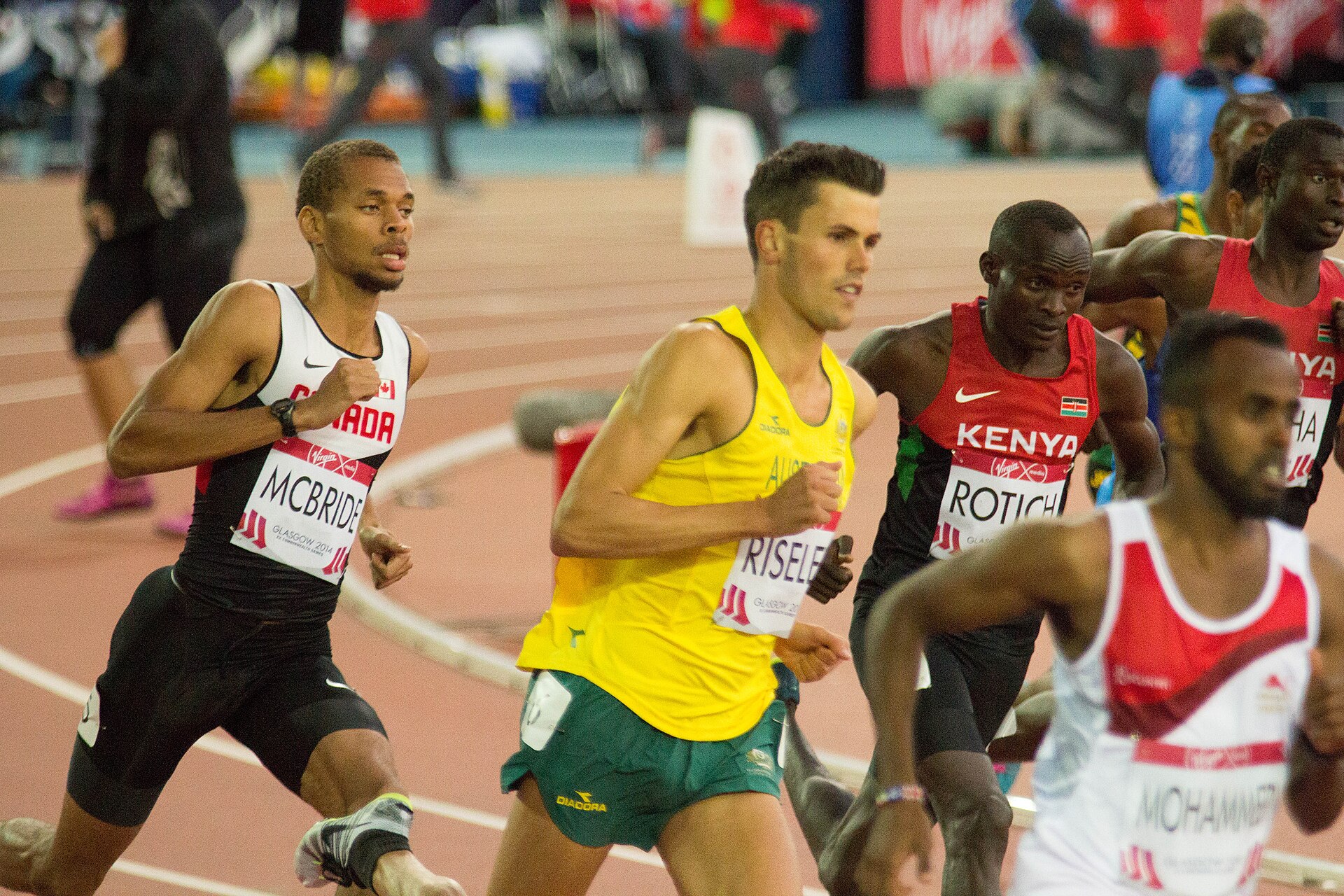
The Long Way Home to Make the Team: How US Collegiate Runners Carried Kenya's Diaspora to Glasgow
Days after the NCAA finals in Oregon, six Kenyan student-athletes flew into Nairobi's thin air and raced their way onto Team Kenya for the Glasgow Commonwealth Games.

When Rosemary Longisa stepped off her flight into Nairobi, her legs still carried the fatigue of a season that had ended only days before, half a world away. She had just been crowned a national collegiate champion on a fast, low-lying track in Eugene, Oregon. Now she was home, where the air thins out above 1,700 metres and the body has to relearn how to breathe between strides. Within hours she would be lining up at Nyayo National Stadium, not as a visiting student but as a contender for a place on her country's team.
Longisa was not alone. She was one of six Kenyan athletes based at American universities who made the long journey back for the national trials in mid-June, and who left with something many established professionals did not: a ticket to the 2026 Commonwealth Games in Glasgow.
A Season That Never Paused
The timing was brutal. The athletes had finished competing at the National Collegiate Athletic Association championships in Eugene barely a week before the Kenyan trials opened at Nyayo. There was no off-season, no taper, no easing back into form. They flew straight from one of the most demanding meets in American athletics into another that would decide whether they could represent the country of their birth.
The altitude alone is a story. Hayward Field, the storied stadium in Eugene where the NCAA finals were held, sits roughly 150 metres above sea level. Nairobi rises to between 1,700 and 2,400 metres. For a middle-distance runner, that difference is felt in every lap — the lungs work harder, the recovery comes slower, the legs that felt light in Oregon suddenly feel borrowed. That the diaspora athletes competed at all was notable. That they won places against seasoned domestic rivals was, by any measure, remarkable.
Six Names, Six Events
The contingent spanned the track and the field. Longisa, the newly crowned NCAA 1,500 metres champion who runs for Iowa State University after transferring from Washington State, earned a spot in the women's one-mile team, where she will line up alongside Naomi Korir and Teresia Gatweri. Janet Amimo of the University of Kentucky, who placed eighth at the NCAA final in 1:59.82, made the 800 metres squad.
Kentucky, in fact, supplied three of the six. Alongside Amimo, Vanice Kerubo secured selection in the 400 metres hurdles, and Rukia Nusra claimed the 100 metres hurdles berth. In the field events, Kevin Kemboi of Oklahoma State University booked his place in the men's triple jump, while Irene Jepkemboi of Texas Christian University earned hers in the javelin — both events well outside the distance-running tradition for which Kenya is famous.
The Hurdler Who Broke the Clock
Among the six, Nusra's rise stands out. During the NCAA East semi-finals she became the first Kenyan woman to run the 100 metres hurdles in under 13 seconds, stopping the clock at 12.96. In the final she went faster still, to 12.88. Her selection came by way of a wildcard, a recognition that her sprint-hurdles times now belong in continental and global conversation rather than at the margins of a country defined by its distance runners.
For a nation whose athletics identity has been built on the steeplechase and the marathon, the spread of these six selections matters. A triple jumper, a javelin thrower and two hurdlers reaching the national team is a quiet signal that the talent pipeline is widening — and that much of the widening is happening on American college campuses.
A Pipeline Paved With Scholarships
The six are part of a far larger cohort. More than 300 Kenyan athletes are currently competing on athletics scholarships at universities across the United States, according to figures reported by the Daily Nation. For decades, the NCAA system has functioned as an informal development academy for Kenyan sport: world-class facilities, a dense racing calendar, coaching, and a degree at the end of it.
Many of Kenya's most decorated names passed through that system before reaching Olympic and world-championship podiums. The pathway offers something the domestic circuit often cannot — financial stability and education running in parallel with elite competition. The trade-off is the very dislocation these six just endured: a life lived between two time zones, two seasons and two sets of expectations.
What Glasgow Will Mean
The Commonwealth Games run in Glasgow from July 23 to August 2, a slimmed-down edition of the event built around a tighter cluster of sports. For the wider Kenyan team — headlined by sprinter Ferdinand Omanyala and a deep distance squad — Glasgow is a championship to win. For the diaspora six, it is something more layered.
These are young people who train in Lexington and Ames and Stillwater, who file into American lecture halls between sessions, and who will now pull on the Kenyan vest on a Scottish track. Their selection collapses the distance the diaspora usually feels. A family in Nairobi and a coach in Kentucky will watch the same race, the same name, the same flag.
The Camp at Kasarani
After the trials, the athletes were due to report to the residential training camp at the Moi International Sports Centre in Kasarani, joining teammates who had already begun preparing. The weeks before Glasgow will be spent reacclimatising to the altitude many of them grew up in but had trained away from, and rebuilding the sharpness lost in transit.
In an interview after the trials, Longisa described making the team as a dream come true, even while admitting the travel had left her tired. It is a small line, but it captures the shape of the whole story: exhaustion and pride arriving in the same breath. Six athletes took the long way home, and the reward was the right to leave again — this time wearing their country's colours.