The Anniversary the State Cannot Script: How June 25 Returns to Test Ruto, the Streets, and a Watching Diaspora
Two years after the Gen Z revolt that shook Kenya, a victim-compensation fund and fresh warnings about 'goons' collide on the eve of June 25 — as Kenyans abroad watch home again.
In February, a small crowd gathered on the pavement outside the Supreme Court in Nairobi. They were not lawyers or party officials. They were mothers holding framed photographs, young men leaning on crutches, and families who had travelled from distant counties to stand quietly in the city and be counted. Eighteen months after the protests that filled Kenya's streets in the middle of 2024, they were still waiting — for names to be read into a record, for officers to be questioned, for the state to say out loud what had happened to their children.
This week, that wait collides with an anniversary. On Thursday, Kenya marks two years since June 25, 2024, the day the #RejectFinanceBill movement brought the largest demonstrations in the country's history to the doorstep of Parliament. For the families on that pavement, and for the millions who followed 2024 unfold on their phones — including a large and vocal Kenyan diaspora — the date has hardened into something the government can neither fully embrace nor make quietly disappear.
Two messages from one government
The state is approaching the commemoration speaking in two voices at once.
In one, it offers repair. President William Ruto has confirmed a Sh2 billion fund to compensate Kenyans harmed during the protests, presenting it as a gesture of national healing rather than, in his framing, a reward for violence. He has extended the term of the Panel of Experts on Compensation of Victims of Human Rights Violations by a further 90 days, a window that now runs into September. For families who have spent two years describing their losses to commissions and television cameras, it is the closest the government has come to an official acknowledgement that something was done to them.
In the other voice, the state warns. Ruto has directed his security chiefs to deal firmly with what he calls "goons" — young people he says are being recruited by politicians who have run out of answers and turned to causing destruction. Interior Cabinet Secretary Kipchumba Murkomen put the contradiction unusually plainly in a televised interview: "I cannot guarantee there will be no goons. I can only guarantee security." It was a candid admission that the figures most associated with violence at recent demonstrations are precisely the ones the state finds hardest to keep off the streets.
The arithmetic of healing
The compensation promise is real, but it sits inside questions the government has not answered.
Two billion shillings is a substantial line for a Treasury straining under debt repayments, and its announcement signals that the administration accepts, at least in principle, that citizens were wronged. Yet the panel charged with deciding who qualifies, how much they receive, and on what evidence has had to be extended rather than completed — its life pushed out by another three months. Families describe a process that asks them to relive the worst days of their lives without a clear timeline for restitution at the end of it.
For the diaspora that sent money home through those weeks in 2024 — for funeral costs, for hospital bills, for legal fees — the gap between a headline figure and a disbursed shilling is familiar. Remittances remain Kenya's single largest source of foreign exchange, and in the aftermath of the protests they often moved faster than any state fund, landing in M-Pesa wallets within hours of a phone call. The reparations debate is, in part, a question of whether the state can finally do for victims what their relatives abroad have been doing all along.
A protest the police call illegal
The commemoration itself is contested before it begins. Nairobi's police commander has declared that any Gen Z protest on the day would be illegal, saying officers have not been formally notified of a planned gathering. Organisers see it differently: opposition figures including Siaya Senator James Orengo and Martha Karua are among leaders who say they notified the Inspector General of plans for nationwide demonstrations to remember those killed in 2024, and victims' groups have announced a longer stretch of remembrance running over several days in the capital.
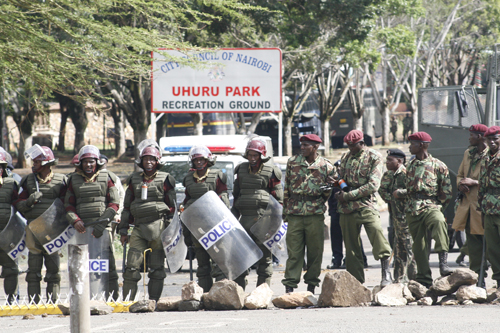
The choreography of recent anniversaries is already reassembling — barricades and razor wire near Parliament and State House, businesses weighing whether to open, and a city bracing for the possibility that a day meant for mourning becomes a day of confrontation. The unresolved argument over whether the streets belong to the state or to the grieving is, two years on, the heart of the matter.
Why the diaspora is watching again
June 25 was never only a Nairobi story. In 2024 it travelled at the speed of a livestream, and Kenyans abroad were among its most relentless amplifiers — running hashtags through the night across time zones, translating events for foreign audiences, and organising solidarity demonstrations outside Kenyan embassies and consulates from Washington to London. For a generation that left home for work or study, the protests were a way of staying tethered to a country they still claimed.
That involvement carried weight precisely because so many of the diaspora's host nations — the United States, the United Kingdom, Canada, and several European partners — are also Kenya's largest aid and trade allies. When Kenyans abroad press their adopted governments to pay attention, those messages can travel back into diplomatic channels. The anniversary is therefore watched not just in Kikuyu and Kisumu but in Kennesaw and Croydon, by people who vote, lobby, and remit in the places that hold Nairobi's economic lifelines.
A date that has acquired its own life
What unsettles the government is that June 25 has slipped beyond official control. Like Saba Saba before it — the July date that recalls the struggle for multiparty democracy a generation ago — the anniversary survives because the business beneath it is unfinished: accountability for the dead, justice for the injured, and answers for a cohort that refuses to forget.
A compensation fund can acknowledge harm, but it cannot by itself settle the question of who is responsible for it. A warning about goons can fill the streets with officers, but it cannot decide whether the day is remembered as mourning or as menace. As Thursday approaches, the state is trying to write the script for a story it no longer owns — and a diaspora that helped carry that story the first time is, once again, watching to see how it ends.