The Air Base With Two Stories: Why Kenya's Laikipia Ebola Plan Now Hinges on Who Walks Through the Door
On Saturday night, Health CS Aden Duale told Citizen TV the Laikipia centre will be run by KDF and will admit Kenyans. The diaspora is still asking what changed.
It was almost midnight in Nairobi when the Health Cabinet Secretary leaned into the studio lights at Citizen TV and tried, on the last hour of a Saturday, to retake control of a story that had run away from him all week. Across continents, Kenyans in Maryland, Manchester and Melbourne were refreshing news feeds before bed, watching the country argue about a clinic on an air base most of them had never heard of until a few days ago.
Aden Duale's message to the country and, in effect, to the diaspora watching from abroad, was short and pointed. The Laikipia Ebola containment centre at the centre of an unusually loud national row will be run by the Kenya Defence Forces. It will admit Kenyans if cases are detected. It is not a foreign hospital pretending to be Kenyan; it is, he said, a Kenyan facility working with foreign support.
Whether that framing holds will depend on what the court in Nairobi decides over the next several days, what the United States agrees to in writing, and whether Kenyans, here and abroad, accept that the same word, partnership, can still mean what they once thought it meant.
Eleven Centres, One Headline
The Laikipia facility has dominated the news, but Duale repeatedly tried to widen the lens. The Laikipia centre, he told Citizen TV, is one of eleven being established across the country in readiness for a possible spillover of the Ebola outbreak now climbing in the Democratic Republic of Congo, where the World Health Organization recently elevated the health risk to its highest level.
Each centre, the minister said, will combine quarantine, isolation and treatment functions. The country's laboratories, he added, are being primed to run around the clock if Ebola is detected, with several partner nations talking to their capitals about supplying the reagents that make rapid testing possible. The picture he painted was not of a single American compound on the savannah, but of a national network in which Laikipia is one node.
What made his Saturday-night appearance unusual was the audience he seemed to be addressing. By the time he spoke, the row had already drawn coverage from CNN, CBS News and Time magazine, and the Kenyan court case had been carried by every major paper in Nairobi. Kenyans abroad, who tend to first encounter such stories through diaspora-focused outlets like Mwakilishi, had been arguing about it in WhatsApp groups all week.
From U.S. Personnel to a Major General
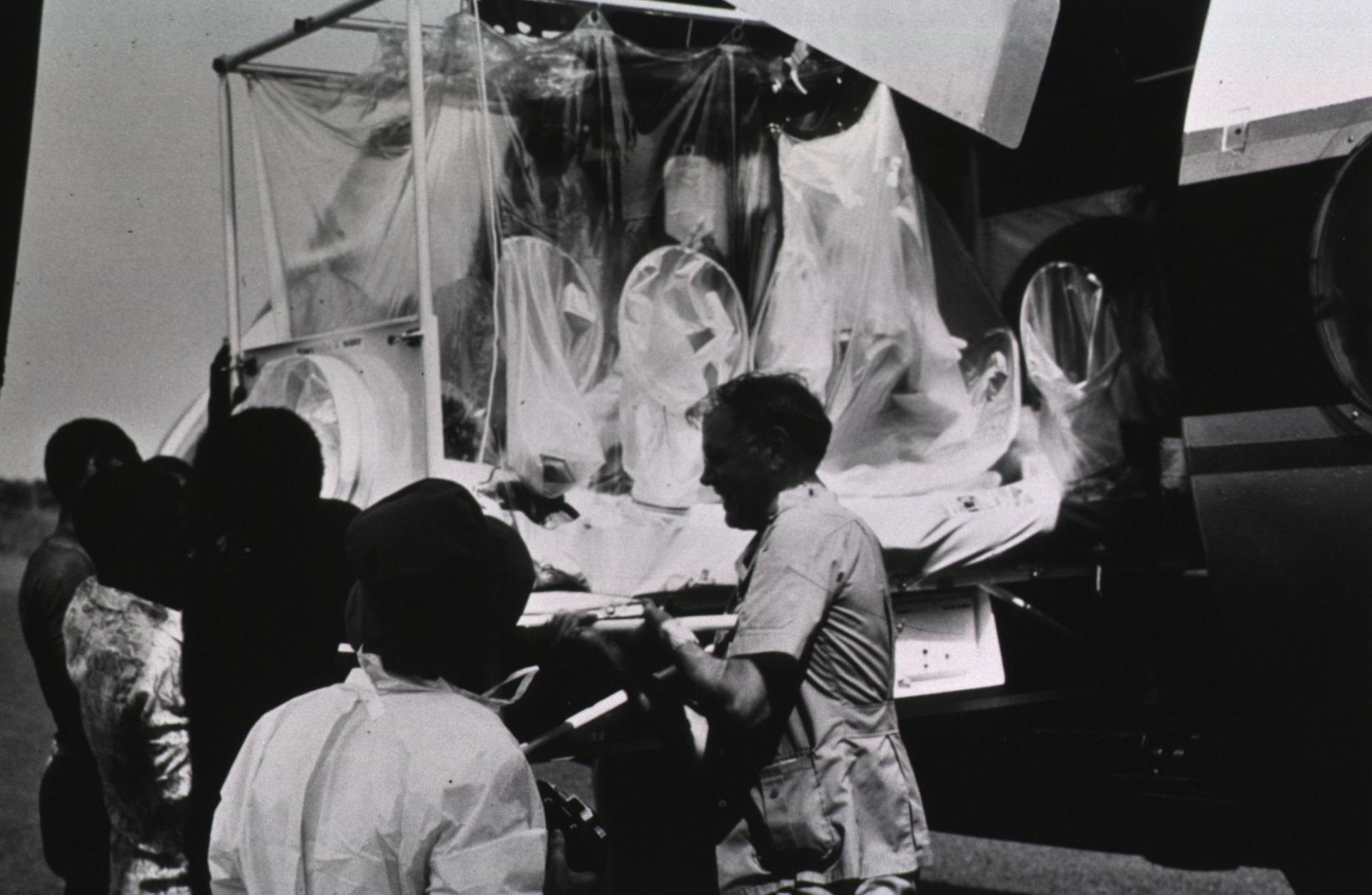
The most consequential line of Duale's interview was the one about command. Earlier reports, including the lawsuit filed by the Katiba Institute, had described a facility designed primarily to hold up to fifty American citizens exposed to Ebola in the region. Some accounts suggested it would be staffed by U.S. practitioners and serve only Americans.
Duale rejected that framing. The Laikipia centre, he told Citizen TV, will sit at the Laikipia Airbase under the Kenya Defence Forces. The KDF's medical wing, he said, is led by a major general and is among the most capable in the country. To make the point harder to dismiss, he reminded viewers that Kenya already deploys its own military personnel in Congo, where Ebola circulates today.
It is a small linguistic shift with large political consequences. A foreign hospital on Kenyan soil is a sovereignty question; a Kenyan military hospital that accepts foreign patients alongside its own is a public-health one. The minister, in effect, asked the country and the diaspora to accept the latter description and stop using the former.
Why the Diaspora Is Watching Closely
For Kenyans abroad, the Laikipia argument is not abstract. Many have relatives who live within driving distance of Nanyuki and Nyahururu. Many work in healthcare systems in the United States, the United Kingdom and the Gulf, and recognise the shape of an Ebola preparedness plan when they see one. And many are wary, after years of pandemic politics, of any arrangement that begins with a foreign government and ends with a Kenyan address.
Kenya's own diaspora-focused outlets have led with the story this week. Mwakilishi reported the High Court's interim suspension, granted after the Katiba Institute argued that the project lacked public participation and parliamentary oversight, and that it compromised the rights to life, health and fair administrative action. The institute's executive director, Nora Mbagathi, said the government should not prioritise expediency over the safety of Kenyan citizens.
On the U.S. side, the State Department has said it is in touch with Kenyan officials and ready for talks, a posture Mt Kenya governors led by Nyeri's Mutahi Kahiga met with a blunt demand to be consulted before anything else is signed.
The Court Order Still Hangs
Whatever happens on television, the Laikipia centre cannot move without surviving Nairobi's High Court. The interim ruling gave the government 48 hours to respond formally to the suspension. Duale's interview did not retire the case; if anything, it raised the stakes by committing the government, in public, to a version of the facility very different from the one originally described.
Katiba Institute's complaint is procedural at its core. The Constitution requires public participation in decisions of this weight, and Parliament, the institute argues, has not been allowed to scrutinise an arrangement that touches sovereignty, security and disease control at once. A KDF-led, eleven-site national plan is a much easier thing to defend in court than a single American annex on a Kenyan air base, which is part of why the minister's reframing matters.
What KSh 1.7 Billion Buys
The financial picture also shifted on Saturday night. The United States has pledged KSh 1.7 billion to support Kenya's Ebola preparedness, Duale said, in the same vein as funding from Africa CDC and the World Health Organization. Other countries, he added, are pledging personal protective equipment and laboratory reagents.
For a country whose Ministry of Health is still arguing with Treasury about routine budgets, KSh 1.7 billion is not symbolic. It is the kind of money that pays for trained staff, ambulances, biosafety lab upgrades and the reagents that make Ebola tests possible without sending swabs abroad. The minister's framing is that the money is the price of help, not the price of access; whether the eventual agreement reads that way is the question Parliament and the courts will be left to answer.
The Question Behind the Tarmac
The diaspora's instinct to ask hard questions about foreign clinics on Kenyan land comes from somewhere real. Kenyans abroad have seen, often up close, how partnerships between unequal governments can drift over time toward the stronger party's convenience. They have also seen, in the same years, what an Ebola outbreak does to families when preparedness is thin.
The Saturday-night defence did not answer everything. It did not produce the memorandum of understanding the Katiba Institute wants on the record. It did not put a Kenyan major general's name on a press release. And it did not explain why, in a country with eleven planned centres, this one in particular was the one that drew an American flag in early reporting.
But it did move the debate forward in one important way. The question is no longer simply whether a foreign country can put a clinic on Kenyan soil. It is now whether Kenya's own institutions, civilian and military, courts and Parliament, can convert a partnership into a plan that the country, in Nairobi and in the diaspora, recognises as its own.