The Order in Nairobi and the Team in the Air: How a Laikipia Ebola Centre Has Pulled Mount Kenya and Washington Into a Standoff
Even as the High Court froze a Ksh1.7 billion American quarantine plan, a specialised US Ebola team was preparing to land. For the diaspora, the test is no longer Ebola — it is whether Kenyan courts can hold.
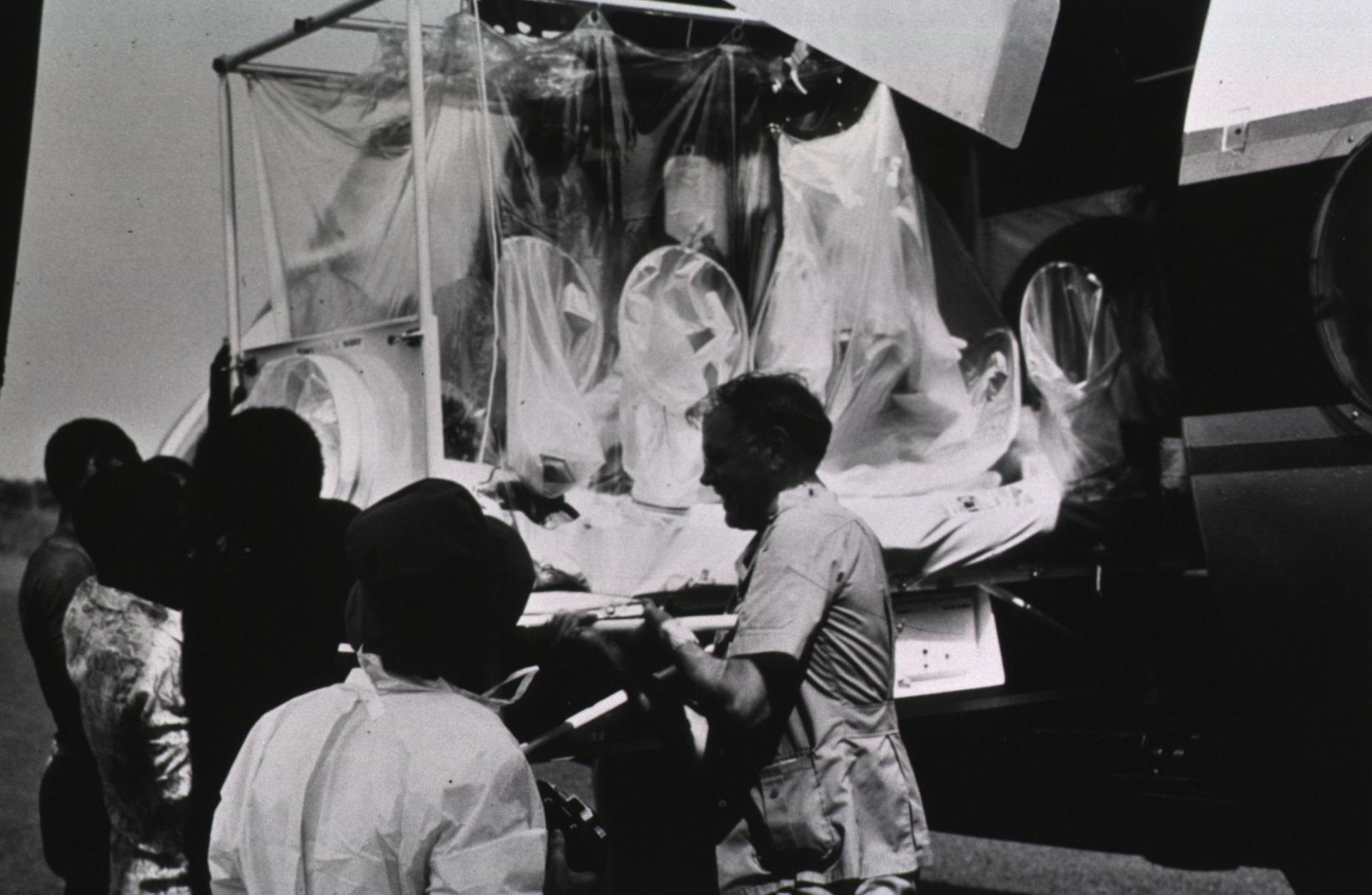
For most of its life, Nanyuki Airbase has been a quiet uniform-and-asphalt sliver of Laikipia County: a base for the Kenya Defence Forces, a runway for low-flying training jets, a stop for British Army units rotating through Ole Naishu, a backdrop the rest of Kenya rarely thinks about. By Saturday morning, it had become the centre of one of the most consequential rows in the country.
On Friday, May 29, the lawmakers representing the same county announced they had unanimously rejected a government plan to host an American-funded Ebola virus quarantine and treatment facility on the airbase. Hours earlier, US officials had told CNN that a specialised Public Health Service Commissioned Corps team was already being deployed to Kenya to staff the centre. And only a day before that, the High Court in Nairobi had ordered the project frozen.
Three jurisdictions, three timetables, one runway.
For the Kenyan diaspora — a community that watches Nairobi politics from Dallas, Minneapolis, Riyadh and Bristol as much as anyone in Kileleshwa — the standoff has stopped being a story about Ebola. It has become a test of who, exactly, gets to decide what Kenyan soil is used for.
A Sleepy Airbase, Then a 1.7-Billion Shilling Headline
The dispute traces back to a December 2025 health cooperation framework signed between the Government of Kenya and the United States — a Ksh322 billion partnership that, on paper, covers a sweeping menu of joint pandemic preparedness, data sharing and outbreak response.
One slice of that menu has now eaten the entire conversation. As an active Ebola outbreak grinds on across the border in the Democratic Republic of the Congo, Washington wants a place to receive American citizens being pulled out of DRC who may have been exposed to the Bundibugyo strain of the virus. President William Ruto, in announcements earlier this month, said that place would be Nanyuki.
Local press reports put the American contribution to the facility at roughly Ksh1.7 billion. Officials have not published a full project document, a budget, or a public timeline. They have, however, named the location, and named it loudly.
The Court Said Stop. The Team Set Off Anyway.
On Thursday, May 28, the High Court in Nairobi handed down conservatory orders blocking the facility while a constitutional challenge filed by the Katiba Institute is heard. Justice Patricia Nyaundi barred the government from facilitating, approving or permitting any Ebola exposure, quarantine, isolation or treatment centre run by the US government or any foreign agency — language broad enough to cover not just Nanyuki, but any version of the deal anywhere in Kenya.
The order should, in normal times, have grounded everything.
It has not. On Friday, the US Public Health Service Commissioned Corps confirmed in a statement carried by CNN that a specialised Ebola response team — physicians, nurses, laboratory technologists, mental health professionals and engineers, several of them veterans of the 2014–2015 Liberia response — is being deployed to Kenya as part of a coordinated effort with the US State Department and the Department of Defense. The statement explicitly mentions training on the Bundibugyo strain. It does not mention the court order.
The Kenyan side has not yet publicly explained how a project that has been judicially paused can have a foreign team already in the air toward it.
Why Laikipia's Own MPs Are Saying No
Inside Kenya, the loudest immediate political pushback has not come from the opposition. It has come from Laikipia's own delegation.
In a joint statement on May 29, the MPs said their "collective conscience" was disturbed by the plan to host the facility in their county. They said they had not been consulted, that local residents had not been briefed, and that the government had not provided a public-health justification for siting an Ebola quarantine hundreds of kilometres from the DRC border. They asked publicly why the facility had not been set up at the source of the outbreak in the DRC for faster and more efficient management.
The procedural complaint is, in some ways, more damaging than the medical one. Kenya's last decade of public-interest litigation has been built on a slow-burning idea: that major decisions affecting a county must include the people of that county. By the MPs' account, that idea was skipped.
Ruto's political base in the Mount Kenya region is already fragile after a year of fuel-price arguments, a stop-start affordable housing programme, and a Finance Bill that critics say will tighten household budgets. A revolt by his own region's MPs over a foreign health installation is not a small line item.
A Petition to Remove the Judges
The picture grew more complicated on Friday evening when Busia Senator Okiya Omtatah filed a fresh petition before the Judicial Service Commission, asking it to investigate three Court of Appeal judges who, on May 12, suspended an earlier set of High Court conservatory orders against the broader Kenya–US health framework. The appellate bench issued the stay but said written reasons would not arrive until October 30, 2026.
Omtatah argues that holding the reasons for nearly five months effectively shuts down any meaningful appeal to the Supreme Court. By the time the appeal court explains itself, he says, sensitive Kenyan health data will already have been transferred and major fiscal commitments already made. He has been careful to frame the complaint as procedural rather than partisan, telling reporters that the issue is not the ruling itself but the procedure that, in his view, blocks timely constitutional review.
If the JSC accepts the petition, Kenya's already-busy judicial calendar grows busier. If it dismisses it, an awkward precedent sets in: that an appellate court can stay a constitutional injunction while withholding its reasoning for months.
What the Diaspora Is Reading Into All of This
For Kenyans abroad, an Ebola quarantine fight in Laikipia might sound parochial. It is not.
A growing share of Western repatriation logistics now passes through Nairobi. Jomo Kenyatta International Airport already serves as a regional hub for embassies pulling staff and citizens out of unstable corners of Central and East Africa. If Nanyuki becomes a stop on that pipeline, every American — including every dual-citizen Kenyan-American — flagged as potentially exposed in DRC could come through Kenya before being cleared to fly on. Diaspora nurses, doctors and biomedical scientists, many of whom remit money home monthly, are watching to see what level of public-health governance their home country signs onto.
There is also the data question. The Katiba Institute's challenge zeroes in on the transfer of Kenyan health information to a foreign government — an issue that resonates with diaspora communities who have spent years lobbying Nairobi for tighter data-protection laws after a string of identity-fraud scandals targeting Kenyans abroad.
And there is the harder-to-name worry that the diaspora carries everywhere: that the country they remit to, the country they plan to retire to, is becoming a junior partner in arrangements it had no time to debate.
What Happens Next
The next test is the case-management hearing on the Katiba Institute petition, expected in early June. The Judicial Service Commission will also have to decide whether to take up Omtatah's complaint or shelve it. And the US Public Health Service team — if it lands in Nairobi this weekend as planned — will need somewhere to stay, somewhere to work, and a legal posture that does not have a Kenyan judge's name on it.
Whatever the diplomats announce next, the question now anchored at Nanyuki is no longer about a single virus. It is about how loudly a Kenyan court order has to be written, and how clearly a Mount Kenya MP has to speak, before a 1.7-billion-shilling plan can be slowed.