The Lane That Home Still Watches: Why a Diamond League Night in Doha Belongs to Kenya's Diaspora
When Kenya's distance stars line up in Doha on Friday, living rooms from Dallas to Dubai will fall quiet — a ritual that keeps a scattered nation tethered to the track.

In a kitchen in Lowell, Massachusetts, a phone is already propped against a cereal box, the stream buffering on a tab kept open since morning. In Dubai a group chat is filling with the same three words — "who's running tonight?" — and in a flat outside Manchester someone has set an alarm for a race that will not start until the children are in bed. None of these people will be in Qatar on Friday evening. All of them will be watching.
The seventh leg of the 2026 Wanda Diamond League lands in Doha on Friday, 19 June, at the Mazzraty Doha Meeting, and for the Kenyan diaspora it is more than another stop on a long athletics calendar. It is one of those recurring nights when distance — the geographic kind — collapses into a single shared screen. The men and women in the green and red vests are, for an hour, the most reliable thing a homesick Kenyan abroad can hold onto.
A Ritual Played Out in Living Rooms Abroad
There is a particular choreography to how Kenyans abroad watch their runners. The work shift gets rearranged. A WhatsApp group that usually trades remittance logistics and visa rumours turns, briefly, into a commentary box. Splits are debated by people who have never set foot on a track. When a Kenyan crosses the line first, the messages come in a flood from three continents at once.
This is the part of diaspora life that rarely makes the immigration headlines: the small, repeated acts of belonging. A Diamond League night does not change a green-card queue or lower the cost of sending money home. But it offers something the policy news cannot — a reason to feel, for an evening, like part of the same country you left.
The Stars Carrying the Flag to Qatar
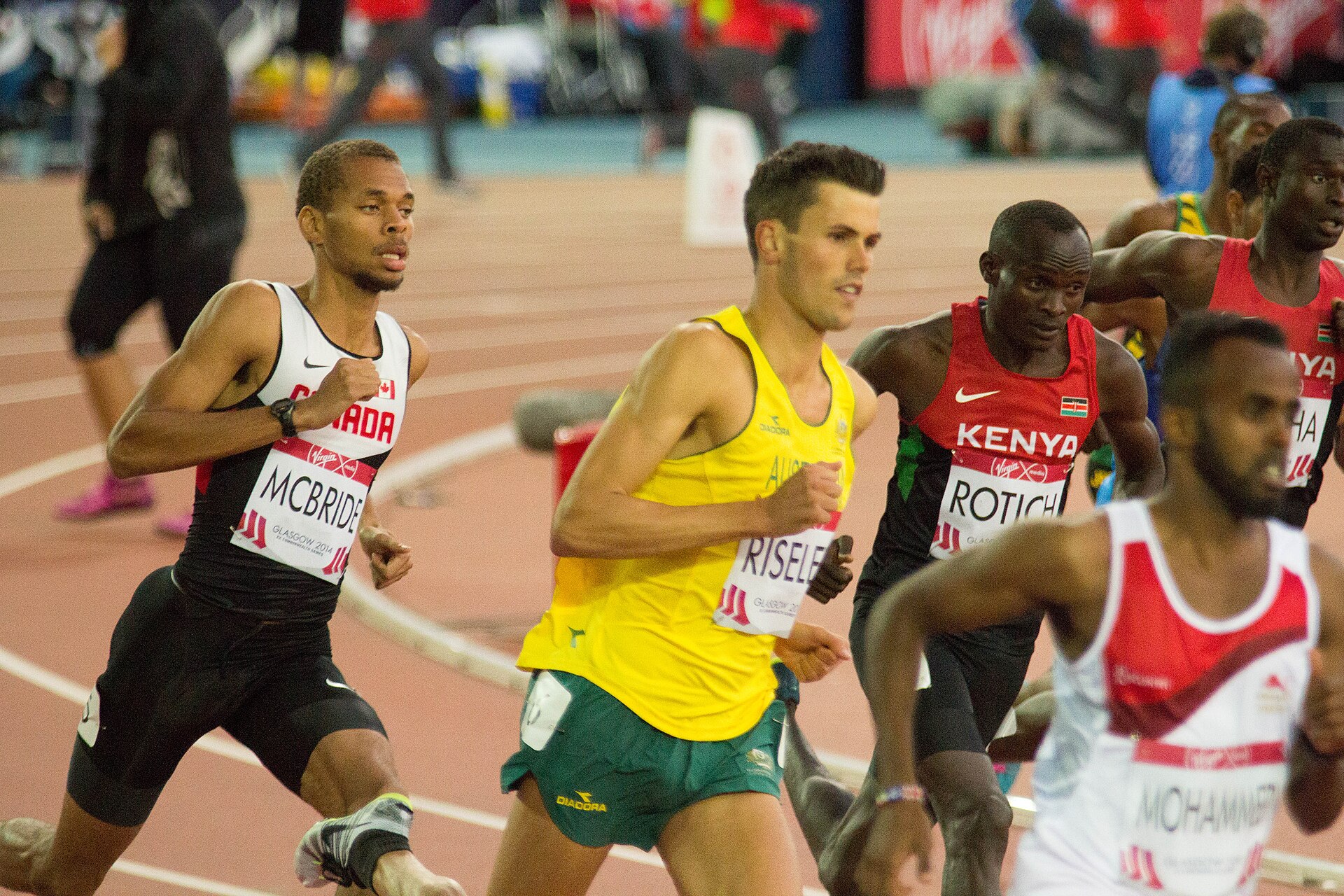
Kenya arrives in Doha with a roster that reads like a roll-call of the country's middle- and long-distance future. Emmanuel Wanyonyi, the reigning Olympic and world 800m champion, is among the headline entries, fresh from a season that has already tested him against a new generation of rivals. At the recent Oslo meeting he was beaten by American teenager Cooper Lutkenhaus, a result that reverberated through Kenyan running circles and gave the Doha trip the feel of a response rather than a routine outing.
Alongside him, the steeplechase contingent draws the eye. Faith Cherotich, the Kipkelion-based Olympic bronze medallist and reigning world 3000m steeplechase champion, has spent the season reinforcing why she is considered the event's standard-bearer; her Diamond Trophy defence came in 8:57.24, comfortably clear of the field. Nelly Chepchirchir, a world 1500m finalist, adds to a 1500m and miling tradition that Kenya treats almost as inheritance.
For diaspora viewers, these are not abstract names. They are the athletes whose victories get screenshotted and pinned, whose interviews get clipped and reshared in community groups from Atlanta to Adelaide.
The Event Kenya Once Owned
No race carries more emotional weight for Kenyan fans than the 3000m steeplechase, and none has become more complicated. For decades the barriers-and-water event was effectively a Kenyan trial held on foreign soil; the only real question was which Kenyan would win. That certainty has eroded. Morocco's Soufiane El Bakkali, the Olympic champion, has built an era of his own, and he heads to Doha in the form that saw him win in front of his home crowd in Rabat for a fifth straight year.
The Kenyan answer is arriving young. Edmund Serem, the 17-year-old reigning World U20 steeplechase champion, has already broken onto the senior stage, clocking 8:34.56 for a global bronze that announced him as the heir to a fading dynasty. For older fans abroad — many of whom grew up on the steeplechase sweeps of the 2000s — watching a teenager try to reclaim the event is its own kind of time travel.
The Runners Who Now Wear Other Flags
There is a quieter, more bittersweet diaspora story threaded through the start lists, and it is one Kenya rarely likes to discuss out loud. When Cherotich defended her Diamond Trophy, the runner-up was Norah Jeruto — Kenyan-born, now competing for Kazakhstan. Jeruto is one of a number of athletes who began on Kenyan soil and now race under the colours of Gulf states, Central Asian republics or other nations that offered citizenship, contracts and a clearer path to a championship vest.
It is, in its own way, the most literal diaspora of all: not nurses in Texas or care workers in the Gulf, but the export of raw athletic talent, recruited and naturalised, sometimes lining up against the very country that produced it. Every major meeting now features at least one Kenyan-born athlete racing for somewhere else, a reminder that the movement of Kenyans across borders extends even to the track.
A Record Within Reach
The other reason Friday matters is the clock. Wanyonyi stands as the joint second-fastest 800m runner in history, his 1:41.11 matching the legendary Wilson Kipketer and trailing only David Rudisha's world record of 1:40.91 — a mark that has stood for nearly fourteen years and is regarded as one of the most untouchable in the sport. Few records are more sacred to Kenyans, at home and abroad, than Rudisha's two-lap masterpiece set at the London Olympics. The prospect that a 21-year-old might erase it has turned every Wanyonyi race into an event in itself, watched less for the result than for the possibility.
A fast Doha track, a deep field and the cooler evening conditions of a Qatari summer night are the kind of variables diaspora fans now parse like analysts. Nobody expects the record to fall this week. Everybody will be watching in case it does.
Why Doha Matters Before the Worlds
The Diamond League is structured as a season-long argument that ends in Brussels on 4-5 September, the two-day final that crowns the year's Diamond Trophy winners. The 2026 series began in Shanghai and Keqiao in mid-May and crosses four continents and fifteen cities before it is done. Doha, as the seventh leg, is where form starts to harden into expectation ahead of the global championship season.
For Kenya's athletics establishment, each meeting is a data point. For the diaspora, it is something less clinical and more durable — a standing appointment with home. On Friday night, somewhere between the kitchens of New England and the apartments of the Gulf, a few hundred thousand Kenyans will tune their screens to the same track, and for the length of a few races the distance will not matter at all.