The Hallway Outside Bay 12: How Johns Hopkins' First All-Black Trauma Team Lands on Every African Family in Baltimore
Five surgeons. Three African surnames. One legacy that begins, on paper, with Vivien Thomas. For Kenyan and Nigerian families two miles from Hopkins, the photograph is not abstract.
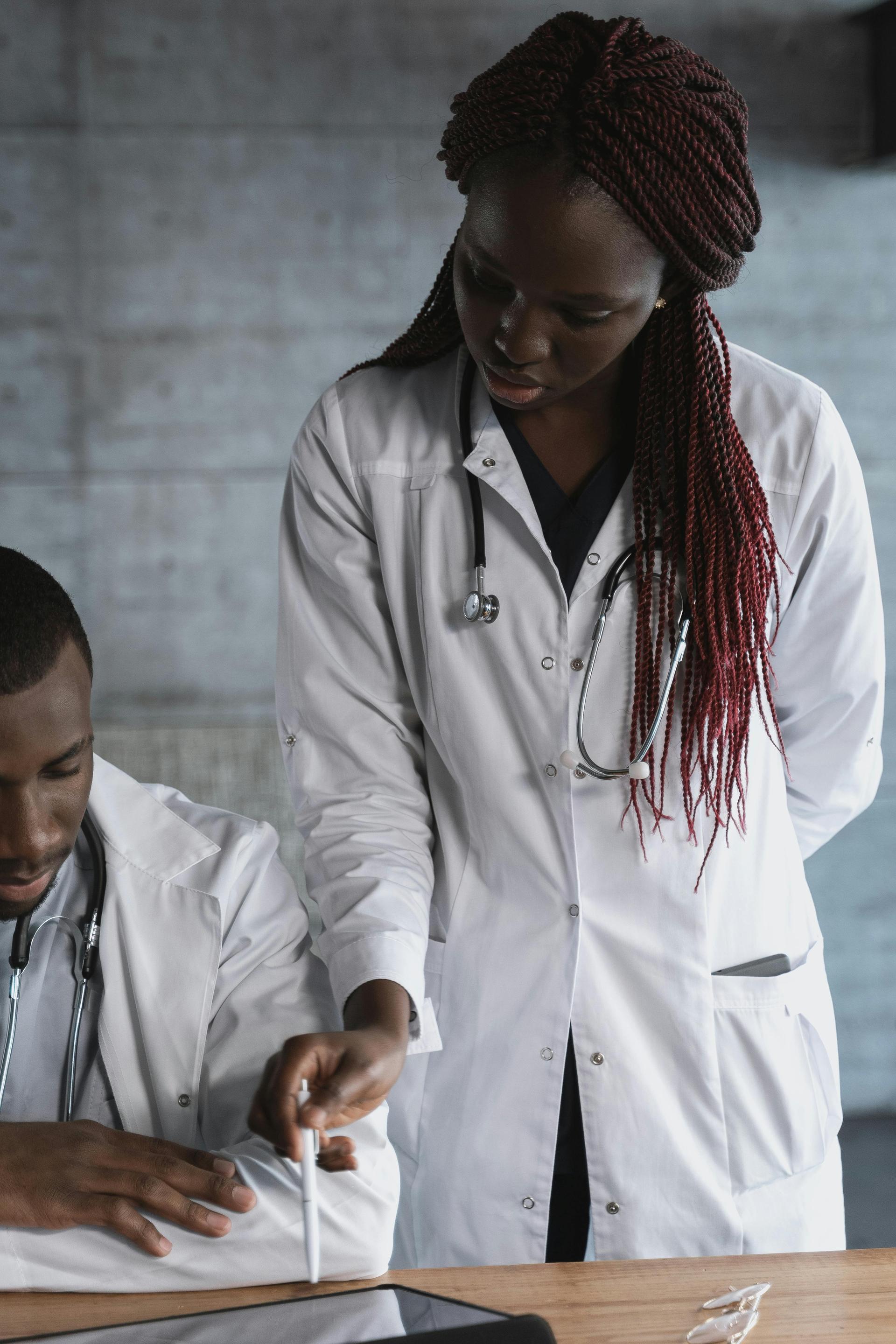
The photograph started circulating in Kenyan diaspora WhatsApp groups in Baltimore on Monday morning, sometime between school drop-off and the start of clinical rounds. Five doctors in long white coats, standing in a corridor at Johns Hopkins Hospital. Two of the surnames in the caption — Shoyombo and Enumah — were ones the older mothers in the group could read out loud without stumbling, because they sounded like home. The hospital had just announced, quietly, that for the first time in its history its flagship trauma and acute care surgery service would be led entirely by Black residents and fellows.
For a community that lives within a few miles of Hopkins — Baltimore is, by most counts, one of the larger Kenyan-American population centres on the East Coast — the image landed with a particular weight. It was not a death announcement. It was not a Green Card alert. It was not a body being repatriated from Oregon. It was a corridor and five young doctors and a story that, for once, was about arrival rather than loss.
A Photograph That Travels Further Than Baltimore
The confirmation came from Hopkins itself and was picked up by Mwakilishi for the Kenyan diaspora audience, and earlier in the year by Essence, BET and Blavity for the broader African-American audience. The hospital said the all-Black trauma team is leading its flagship Halsted Service in Trauma and Acute Care Surgery — the same Halsted name that comes up in every American surgical textbook, attached to William Stewart Halsted, the surgeon who built the operating room as we know it today.
What is being celebrated is not a token panel for a brochure. It is a working rotation. The five residents and fellows will run consults overnight, decide whether a stab wound is going to theatre, scrub in on the gunshot trauma cases that pour into Hopkins from East and West Baltimore on summer weekends, and follow patients into the intensive care unit afterwards. For families across the Black Atlantic — Nigerian, Ghanaian, Kenyan, African-American — the picture is being shared less as a headline and more as proof of concept.
The Five Names on the Halsted Rotation
The team, according to the hospital's own listing carried by Mwakilishi and confirmed by Essence, comprises Dr Valentine S. Alia, a second-year resident; Dr Ivy Mannoh, a third-year resident and the only woman on the team; Dr Ifeoluwa "Ife" Shoyombo, also a third-year resident, who carries the additional degrees of an MPH and an MS; Dr Lawrence B. Brown, a seventh-year resident with a PhD and an MPH; and Dr Zachary Obinna Enumah, a ninth-year resident and critical care fellow with a PhD and an MA.
The surnames do not all sit on the same branch of the diaspora. Shoyombo is read across West Africa as Yoruba, from southwestern Nigeria. Obinna, Dr Enumah's middle name, is Igbo, from the southeast. The Brown surname, in Baltimore in particular, often traces back through generations of African-American families who have lived within walking distance of the hospital long before the residents now leading it were born.
In a quote carried by Mwakilishi and earlier reported by Essence, Dr Brown — the first physician in his family — placed the moment in plain words. "Medicine is not just science, it's also service," he said. "Equity must remain at the forefront of how we deliver patient care, conduct research, and scale programs within our healthcare system." Dr Enumah, raised in Columbus, Georgia in the 1990s by a mother in family medicine and a father in general surgery, described watching his parents show up for patients every day as the thing that shaped his own path into the same room.
What the Numbers Still Say in 2026
The achievement sits against a quietly stubborn statistic that the hospital itself surfaced in its announcement. Only 5.6 per cent of surgeons in training in the United States are Black, against a Black share of the US population of roughly 13.4 per cent. For Black women in surgery the figure is smaller still. That is the gap an all-Black Halsted rotation gestures at — and the gap it does not, on its own, close.
For the Kenyan-American medical community the numbers carry a separate echo. Kenyan-trained nurses have for years been one of the most heavily recruited healthcare workforces in Maryland, in Texas, in Minnesota and increasingly in the United Kingdom and Canada. They mostly enter at the bedside. The pathway from a Kenyan nursing diploma to a Hopkins surgical residency is long, expensive, and littered with visa renewals, exam re-sits and unpaid years of research fellowship. A photograph of five Black surgeons in a Halsted hallway does not collapse that pathway. It does mark it.
The Shadow of Vivien Thomas
To understand why the announcement is being treated as historic rather than incremental, it helps to know that the new team is working in the institutional shadow of Vivien Thomas. Thomas was a Black laboratory technician without a medical degree who, in the 1940s, helped develop the surgical technique that saved so-called "blue baby" infants suffering from a congenital heart defect. His name was kept off the early publications. He was, by many accounts, the first Black person to wear a white coat inside Johns Hopkins. His portrait now hangs on a wall there.
The Halsted service is the prestige surgical service at Hopkins. To have five Black doctors run it together, in 2026, is not unrelated to the long, uneven work of correcting Thomas's erasure. The hospital has made that connection explicit in its announcement, and so have the residents themselves in their public statements.
Why African Families in the US Read This Differently
For Nigerian and Kenyan parents in particular, the picture lands at a moment when the broader US immigration mood feels narrower than it has in years. The same week that Hopkins announced the rotation, the Department of Homeland Security clarified a so-called Return Home directive for certain long-term Green Card holders, immigration officers continued to push more applicants to interview from abroad, and the UK quietly raised its Skilled Worker salary threshold to thirty-one thousand pounds. Children of doctors and nurses in the diaspora are watching these announcements in real time on their parents' phones, between English homework and supper.
A photograph from inside Hopkins does not change immigration policy. It does change what a fourteen-year-old in a Baltimore row house, or in a flat in Sydenham in Nairobi, can picture for themselves. It tells a Yoruba teenager that an Igbo middle name can sit comfortably at the head of the trauma service at one of the most prestigious hospitals in the world. It tells a Kenyan nursing mother in Highlandtown that her daughter's path, if she chooses it, has been walked before her.
The five doctors will keep doing what residents and fellows do — long shifts, harder cases, paperwork at three in the morning, a quiet coffee before the next page. The photograph will keep circulating. And in Baltimore's Kenyan churches this coming weekend, more than one mother will print it out, fold it into her Bible, and show it to her daughter without saying very much.