The Oath She Crossed an Ocean to Take: How a Kenyan Soldier from Kapkatet Became an American Citizen in Uniform
Mercy May Jerono left Kericho County and enlisted in the U.S. Army as a non-citizen. This week she took the oath of allegiance — joining nearly 50,000 foreign nationals serving in American uniform.
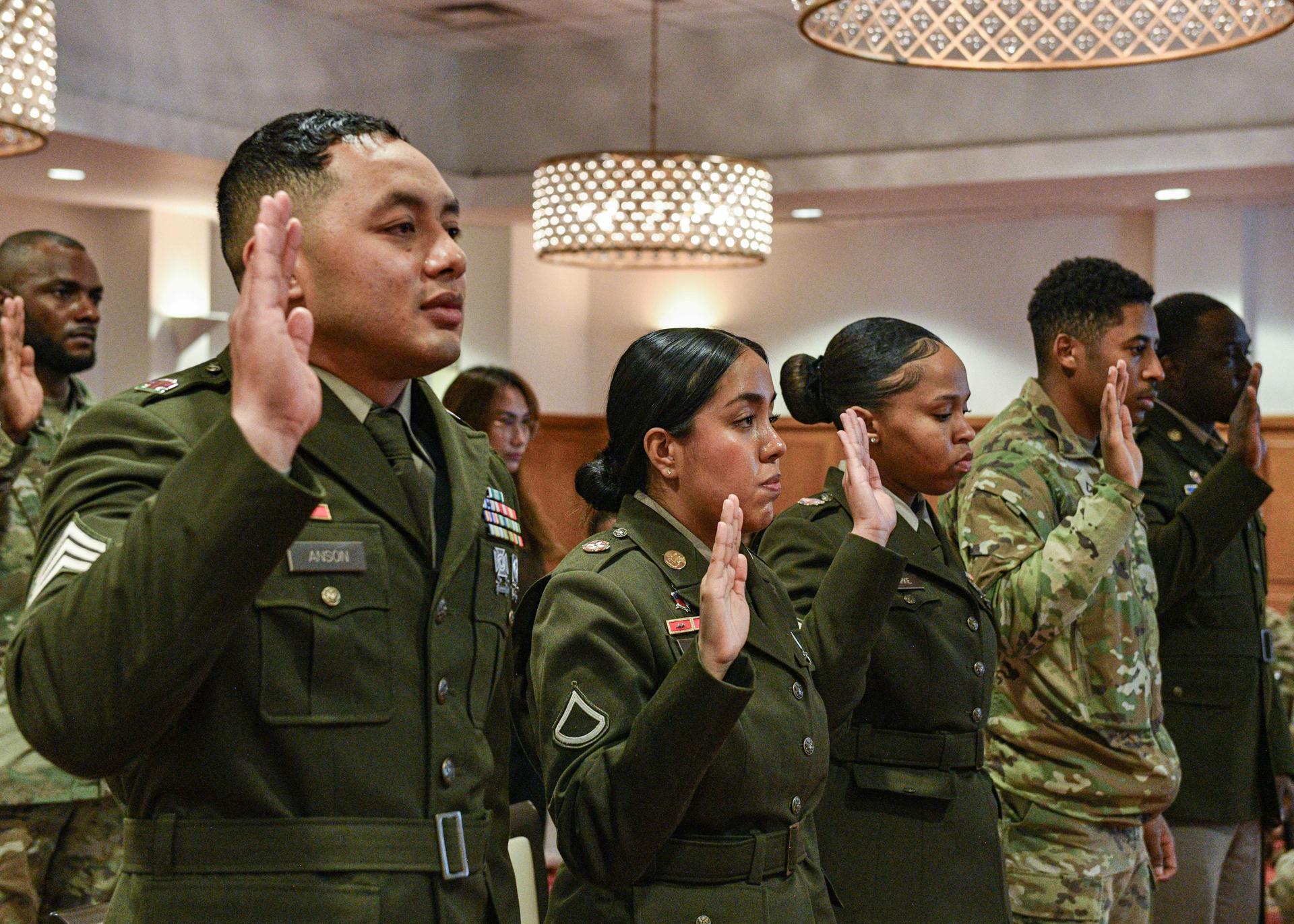
The photographs did the announcing. In them, a young woman stands in the camouflage of the United States Army, her right hand raised, her face caught somewhere between concentration and disbelief. Within hours of being shared online, the images had traveled the length of the Kenyan diaspora's group chats and timelines — from Nairobi to Dallas, from Kericho to the comment sections where strangers wrote that they were proud of a woman most of them had never met. Mercy May Jerono had just become an American citizen, and she had done it in uniform.
For Jerono, who is from Kapkatet in Kericho County, the oath of allegiance was the end of a long road and the start of another. According to Mwakilishi, the Kenyan diaspora outlet that reported her story, she enlisted in the U.S. Army as a non-citizen, completed the training and service the military demands, and only then took the step that converts a green card and a sense of belonging into the legal fact of citizenship. The site noted that her naturalization followed years of service — a sequence that thousands of immigrants in American uniform know intimately, and that most Americans never see.
From Kapkatet to the Recruiter's Office
Kapkatet is tea country, a cool, green stretch of the Rift Valley highlands where the days are organized around the picking and the weighing of leaves. It is a long way, in every sense, from a U.S. Army installation. Mwakilishi's account of Jerono's life is brief, and this report does not go beyond it: she left Kericho, she arrived in the United States, and at some point she walked into the orbit of a military recruiter and signed her name.
That decision placed her inside one of the oldest and least-discussed bargains in American immigration. The country has, since its founding, asked immigrants to help fight its wars, and has periodically rewarded that service with the citizenship it might otherwise have made them wait years to earn. Jerono's path was neither a shortcut nor a loophole. It was a route laid down in statute, available to a specific group of people willing to accept a specific kind of risk.
A Path Written Into Immigration Law
The legal machinery behind Jerono's oath sits in two sections of the Immigration and Nationality Act. Under INA Section 328, a non-citizen who has served honorably in the U.S. armed forces for at least one year may apply for naturalization. Under INA Section 329, those who serve during periods the president designates as times of hostility can apply even sooner. The U.S. Citizenship and Immigration Services, the federal agency that administers the process, states plainly that applicants under either provision pay no fees — a not-incidental detail in a system where the cost of naturalization is itself a barrier for many.
Enlistment, though, comes first, and it has its own gate. Federal law generally limits military enlistment to U.S. citizens and nationals, lawful permanent residents, and citizens of a handful of Pacific nations in compact with the United States. In practice, that means most foreign-born recruits arrive at the recruiter's office already holding a green card. The uniform does not replace the immigration system; it runs alongside it, offering a faster and cheaper exit ramp to citizenship for those who qualify and serve.
Nearly 50,000 in Uniform
Jerono is far from alone. As of February 2026, according to figures compiled in a Congressional Research Service review of foreign nationals in the armed forces, nearly 50,000 non-citizens were serving across the active and reserve components of the U.S. military. They cook and code and drive and deploy; they fill billets the all-volunteer force has historically struggled to keep full. For the Pentagon, immigrant recruits are not a charity case but a manpower asset.
Washington has lately tried to make sure those recruits know the citizenship door exists. The National Defense Authorization Act for fiscal year 2022 directed each military department to notify non-citizen recruits and service members of their eligibility to naturalize — both when they enlist and when they leave. The Department of Defense indicated it intended to have that notification system fully in place by the end of March 2026. The mandate exists because, for years, eligible service members slipped out of uniform without ever being told that the country they had served would have made them citizens for free.
What Citizenship Changes — and What It Doesn't
For a soldier like Jerono, the oath is more than ceremony. Citizenship unlocks security clearances that many military career paths require, opens officer commissioning routes that are closed or constrained for non-citizens, and removes the quiet vulnerability of serving a nation that could, in theory, still deport you. It also ends the paperwork — the renewals, the re-entry anxieties, the sense of being a permanent guest.
What it does not do is rewrite where she comes from. Jerono remains a daughter of Kapkatet, and the pride that rippled through Kenyan networks online was precisely the pride of a community claiming one of its own. Mwakilishi noted that her story circulated alongside others — including a Kenyan woman it identified only as Sheryl, who recently described becoming a U.S. citizen after beginning her journey on a fiancé visa, and who urged others to persist. The throughline is not the visa category. It is the patience.
A Diaspora Watching
That Jerono's moment landed so loudly says something about the season the Kenyan diaspora in America is living through. This is a community that, in recent weeks, has tracked a proposed sharp rise in U.S. citizenship fees, a Supreme Court decision touching the rights of returning green card holders, and a general tightening of the immigration climate. Against that backdrop, a clean, uncomplicated success — a Kenyan woman raising her hand and being welcomed in — carries extra weight. It is proof, however singular, that the path still runs.
It would be easy to over-read a single oath. Jerono's route through military service is open only to those who qualify to enlist and are willing to serve, and it is not a substitute for the family and employment channels most Kenyans use to build lives abroad. But her photographs traveled for a reason. In a year when so much diaspora news has been about doors narrowing, here was one that opened — and a young woman from the tea highlands of Kericho walking through it, in the uniform of her adopted country, an American citizen at last.