The Delete Button Denied: Kenyan Court Strikes Down Website-Blocking Powers That Haunted the Diaspora's Digital Town Square
Kenya's High Court has voided the state's power to block websites and the vague offence of cyber harassment — a ruling Kenyans abroad watched as closely as anyone at home.

It was mid-morning in Nairobi on Thursday when the ruling landed, and by the time the courthouse corridors had cleared, screenshots of the headline were already moving through Kenyan group chats in Dallas, Milton Keynes, Doha and Melbourne. For a community that lives its Kenyan life almost entirely online — the family WhatsApp thread, the X spaces on election season, the diaspora news sites that stitch fifty scattered cities into one conversation — this was not an abstract judgment about statutory drafting. It was a ruling about the room where the diaspora actually lives.
The High Court declared key sections of the Computer Misuse and Cybercrimes (Amendment) Act, 2025 unconstitutional, striking down the provision that handed a government committee the power to block websites and applications, and voiding the new offence of cyber harassment, according to reporting by Kenyans.co.ke. Justice Patricia Nyaundi found the contested provisions vague and overly broad, and held that they failed the strict test that Article 24 of the Constitution sets for any law that limits fundamental rights.
What the Court Struck Down
Two provisions were at the heart of Thursday's decision. The first, Section 6(1) of the amendment, empowered the National Computer and Cybercrimes Coordination Committee — a state body known as NC4 — to order the blocking of websites and apps deemed to facilitate unlawful activity. Critics had warned from the start that the provision contained no meaningful judicial check at the point of blocking: a committee of officials could, in effect, switch off a publication or platform first and argue about it later.
The second, Section 27(1), created a broadly worded offence of cyber harassment, which covered communication that could cause a person to fear for their safety or, in one much-debated formulation, messages that might lead someone to harm themselves. Lawyers challenging the law argued that language this elastic could stretch to cover ordinary online criticism — the angry quote-tweet, the unflattering blog post, the heated diaspora forum thread about a governor's foreign trip.
Justice Nyaundi agreed with the challengers on both counts, Kenyans.co.ke reported, finding the sections too vague and too broad to survive constitutional scrutiny. Digital rights advocates greeted the decision as a major victory for online free expression.
A Law That Was Contested From Day One
The amendment act had a turbulent life from the moment President William Ruto signed it on October 15, 2025. It arrived in the shadow of a year of youth-led street protests that had been organised, broadcast and memorialised almost entirely on social media, and its critics read the website-blocking power as an attempt to build a kill switch for exactly that kind of mobilisation.
The challenges came quickly. Within days of the signing, petitioners — among them the musician and digital accessibility advocate Reuben Kigame — were before the High Court, and by late October 2025 Justice Lawrence Mugambi had suspended the website-blocking and cyber harassment provisions pending a full hearing. Thursday's judgment converts that temporary freeze into a permanent constitutional finding, unless a higher court reverses it.
Nor was this the first time Kenyan judges have trimmed the state's cyber-law ambitions. In March this year, the Court of Appeal struck down Sections 22 and 23 of the original 2018 Act — the offences of publishing false information — in a case pursued for years by the Bloggers Association of Kenya, ARTICLE 19 Eastern Africa, the Law Society of Kenya and journalists' unions. The Director of Public Prosecutions has since taken that fight to the Supreme Court. A clear pattern has emerged: Parliament writes expansive digital offences, and the courts, case by case, cut them back.
Why Kenyans Abroad Were Watching
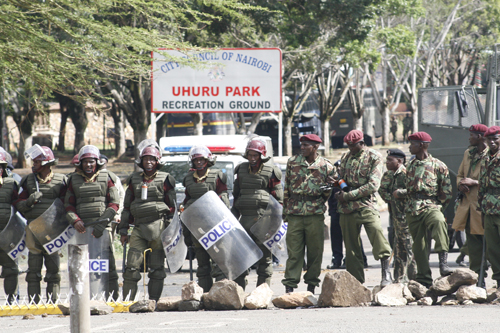
For the diaspora, the stakes in this case were unusually direct. Kenyans overseas are among the country's most prolific online commentators, precisely because the internet is the only public square they can reach. A nurse in Minnesota or a rig worker in Qatar cannot attend a rally in Uhuru Park; they can post, share, argue and donate. Much of the sharpest criticism of successive Kenyan governments has come from accounts run far beyond the reach of Kenyan police — and lawmakers have periodically signalled their frustration with that fact.
The website-blocking power worried the diaspora for a second reason: the sites most likely to be targeted are the ones diaspora readers depend on. Independent digital publications, citizen-journalism outlets and diaspora-run news platforms operate without the institutional protection of legacy media houses. A blocking order signed by a committee in Nairobi would have severed those outlets from their home audience in a single stroke — and severed the diaspora's window into home along with it.
And the cyber harassment offence carried a quieter chill. Diaspora Kenyans travel home; they hold Kenyan IDs, own Kenyan land, bury their parents in Kenyan soil. An offence broad enough to criminalise harsh online speech was broad enough to make a returning critic think twice at the airport. Rights groups documented that anxiety repeatedly during the protest seasons of 2024 and 2025, when online voices abroad amplified what was happening on Nairobi's streets.
What Survives, and What Comes Next
Thursday's ruling does not dismantle the cybercrime framework. The core of the 2018 Act — offences covering hacking, computer fraud, identity theft, child sexual abuse material and phishing — remains in force, as do the bulk of the 2025 amendments. The state also retains the option of appeal, and the government's record suggests it will use it: the DPP's pending Supreme Court challenge over the false-publication sections shows how determined officials are to keep enforcement tools intact.
There is also nothing to stop Parliament from trying again with more carefully drafted provisions. Legal analysts have long argued that a narrowly tailored takedown mechanism, with prior judicial authorisation, could survive scrutiny where NC4's administrative blocking power could not. The battle, in other words, is likely to shift from the courtroom back to the National Assembly.
The Conversation Continues
For now, though, the diaspora's digital town square stays open, and the ruling will ripple through it in familiar ways: celebrated in some threads, dissected in others, dismissed in a few as a lawyers' victory that changes little on the ground. That, in the end, is the point. The arguments — loud, messy, transnational — are precisely what the struck-down sections put at risk, and what Thursday's judgment protects. For the millions of Kenyans whose citizenship is lived through a screen, the court did not just void two sections of a statute. It kept the line home open.