The Bale That Crossed Two Oceans: How East Africa's Mitumba Squeeze Reaches Kenyan Traders in America
As Kenya, Uganda and Tanzania move to tax the second-hand clothing trade more heavily, Kenyan-Americans who built businesses on used bales are recalculating.
On a Friday afternoon in Washington, D.C., a meeting room at the Kenyan Embassy filled with people whose livelihoods sit inside shipping containers. They are the diaspora end of one of the most contested trades between America and East Africa: mitumba, the bales of used clothing that leave US warehouses and arrive, weeks later, in the open-air markets of Nairobi, Kampala and Dar es Salaam. According to Mwakilishi, which reported on the forum on Friday, Kenya's Ambassador to the United States, Lazarus Amayo, came to reassure them. The governments back home, he said, intend any transition in trade policy to be "gradual and minimally disruptive" to those in the used clothing sector.
That reassurance was needed because the ground is shifting. Kenya, Uganda and Tanzania are all, in different ways, moving to squeeze the second-hand clothing trade — and for the Kenyan-Americans who collect, grade, pack and export those clothes, the question is no longer whether the rules will change, but how fast.
A Trade Worth a Billion Dollars
The numbers explain why so much anxiety fits into one embassy meeting room. Kenya is Africa's largest importer of second-hand clothing, according to trade data cited by the BBC: nearly 180,000 tonnes arrived in 2022, a 76 percent increase on 2013. Mwakilishi, citing Kenyan statistics, puts the 2025 figure at roughly 185,000 metric tons — the trade has kept growing even as the policy debate has hardened. The used clothing industry across East Africa is valued at approximately one billion dollars a year, according to figures cited in Mwakilishi's reporting.
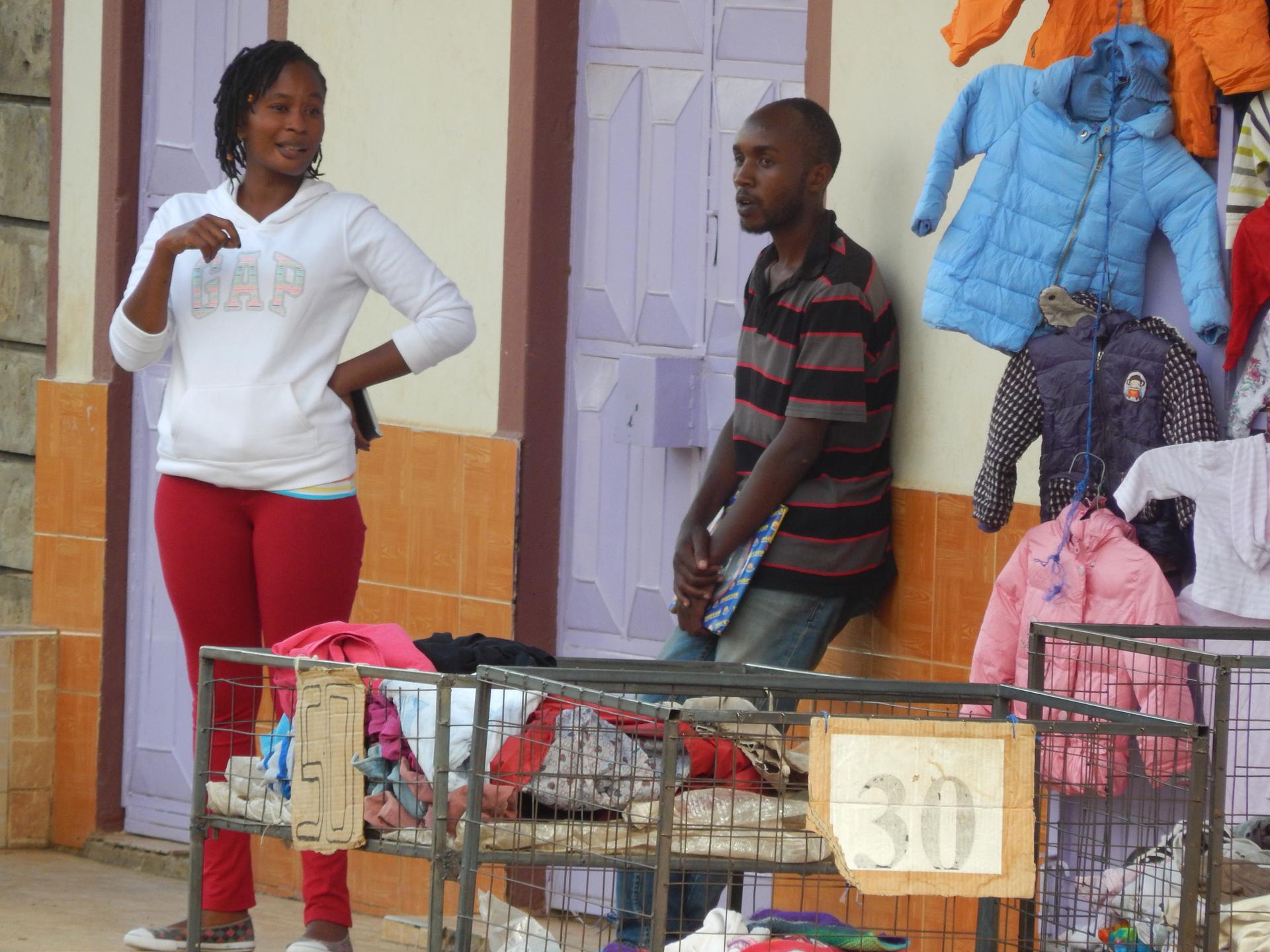
Behind the tonnage are people. Research commissioned by the Mitumba Consortium Association of Kenya estimates that up to 4.9 million people across East Africa rely on the used clothing trade for work — importers, wholesalers, market vendors, tailors who repair damaged garments, and the food sellers who feed them all. The supply chain begins far from Gikomba market: in American thrift-store backrooms, charity sorting centres and diaspora-owned export businesses from Atlanta to Baltimore.
What the Governments Are Doing
The current squeeze is coming from several directions at once. Uganda has introduced a 30 percent environmental levy on used clothing imports, stacked on top of an existing 35 percent import duty and 18 percent VAT — a measure its government says is intended to curb environmental damage while promoting domestic garment production.
Kenya's approach has been more hesitant, and more revealing. The Treasury's Finance Bill this year proposed a new way of taxing mitumba importers: an upfront income tax based on a deemed profit of five percent of the customs value, paid before goods are released, according to reporting by The Star. After a public backlash from Kenyans worried the change would push up prices in the markets, the proposal was dropped from the Bill — though Treasury officials have said they intend to reintroduce it as an amendment. Kenya already applies a 30 percent customs duty to used clothing imports, five points more than new clothes attract.
For an exporter in the United States, each of these measures lands as a line item. Higher duties at Mombasa mean a bale that cleared at one price last year clears at another this year, and the margin that supported a family business narrows.
The Ghost of 2015
Everyone in this trade remembers what happened the last time East Africa tried to go further. In 2015, the East African Community's member states announced they would raise tariffs steeply and eventually ban mitumba imports outright. The United States, a major exporter of used clothing, warned the move would violate trade agreements and threatened to remove EAC countries from the African Growth and Opportunity Act — the arrangement that gives Kenyan goods, including new textiles, duty-free access to the American market.
Every member except Rwanda backed down. Rwanda held firm, raised its per-kilogram tax from 20 cents to 2.50 dollars, and absorbed retaliatory US tariffs on its own clothing exports. A decade later, that history still frames every conversation: AGOA remains, in Ambassador Amayo's words reported by Mwakilishi, a critical component of Kenya's trade strategy. The lesson the region drew is that an outright ban invites confrontation with Washington — which is why the new tools are levies, duties and deemed taxes rather than prohibitions.
The Diaspora's Stake
For Kenyans in the United States, the mitumba economy runs in both directions. Some run export businesses that ship graded bales to relatives or partners who wholesale them in Kenya. Others send remittances that are invested in market stalls back home. A policy change in Nairobi or Kampala therefore reaches an apartment in Atlanta almost as quickly as it reaches Gikomba.
That is why the Kenya Diaspora Alliance has begun convening community leaders. Mwakilishi reports that the organisation's president, Charles Mwangi, told a recent meeting in Atlanta that diaspora businesses must engage both US and Kenyan officials directly, and urged Kenyan-Americans to attend trade policy workshops organised with the embassy. The embassy itself has set up a dedicated hotline and online resources for diaspora members trying to navigate the changes.
Jobs, Waste and an Argument That Won't Settle
The policy debate the diaspora is being pulled into is genuinely unresolved. Proponents of restriction argue that a region saturated with cheap cast-offs can never build its own fashion industry, and that retail-only trade contributes little to national economies. Environmental campaigners add that a large share of what arrives is unsellable: the Changing Markets Foundation estimated in 2023 that more than one in three used garments shipped to Kenya ends up in landfill, in a country with little textile-waste infrastructure.
Defenders of mitumba answer with the 4.9 million livelihoods, with the affordability that put decent clothing within reach of ordinary households, and with the point that re-wearing clothes is itself a form of recycling. They also note Rwanda's experience: as mitumba supply dried up there, customers largely switched not to local brands but to cheap new imports from Asia. Signatories to the Basel Convention, the global waste treaty, are meanwhile weighing whether used garments should be classified as waste — a decision that could raise costs for the trade worldwide, regardless of what East African capitals decide.
What Traders Abroad Can Do Now
The practical advice emerging from Friday's forum was unglamorous: stay informed, diversify, and show up. Diaspora exporters are being encouraged to register for the embassy's workshops, to watch the fate of Kenya's deemed-tax amendment when it returns to Parliament, and to explore adjacent opportunities — including new-textile exports under AGOA — before the rules tighten further. The bale trade that built businesses on two continents is not ending. But the era when it ran on habit, rather than on close attention to policy, appears to be over.