Born in Kakuma, Capped in Green and Gold: Awer Mabil's World Cup Gives Kenyans in Australia a Reason to Fill the Fan Zones
A winger born in Kenya's Kakuma refugee camp has made Australia's World Cup squad — and from Fed Square to Darling Harbour, East Africans across Australia are organising to watch together.
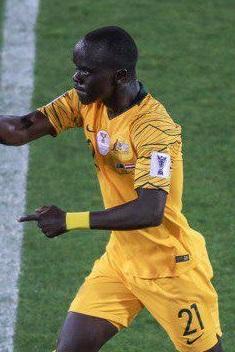
The kettle goes on before dawn in a lot of East African households in western Sydney these days. The group chats are already arguing about kick-off times, because a World Cup played in North America arrives in Australia at unsociable hours: the Socceroos' second group game, against the host United States in Seattle, will hit screens in New South Wales at five o'clock on a winter morning. Nobody in those chats seems to mind. For the Kenyan diaspora in Australia, this tournament has something the last several did not — a face they can claim, in a squad they can cheer, in a country they now call home.
His name is Awer Mabil, and he was born in Kenya.
The Boy Who Left Kakuma at Ten
Mabil's story begins in Kakuma, the sprawling refugee camp in Kenya's northwest, where he was born on September 15, 1995, to South Sudanese parents who had fled the civil war across the border, according to a profile published this week by Kenyan outlet Tuko. He learned the game there, on the camp's dirt pitches, before his family was resettled in Adelaide when he was ten years old.
What followed is the kind of climb that diaspora families recognise in their bones. School at St Columba College. Youth football with local clubs, then Campbelltown City, then a professional debut with Adelaide United in the A-League. In 2015 came the leap to Europe: Danish side FC Midtjylland, where he won a league title and played in both the Europa League and the Champions League. There were loans in Denmark and Portugal, stints in Turkey, Spain and Switzerland, a Czech championship with Sparta Prague, and, today, a contract with CD Castellón in Spain's second division. Along the way he has pulled on the green and gold 37 times and scored ten goals, and Tuko reports he was voted young Australian of the year in 2023 for his charitable work.
This month, coach Tony Popovic named him in Australia's final squad for the 2026 World Cup — Mabil's second, after Qatar 2022, where he came off the bench twice as the Socceroos fell to eventual champions Argentina in the round of 16. "Some difficult decisions had to be made – that's the nature of major tournaments," Popovic said of the selection, which also features veteran goalkeeper Matt Ryan and Cristian Volpato, the Serie A playmaker who recently committed his international future to Australia.
A Group Built for Early Alarms
Australia open their campaign against Turkiye on June 13, meet the hosts in Seattle on June 19, and close the group against Paraguay in the final week of June. Every one of those fixtures lands in Australian living rooms in the morning hours, which is why the question of where to watch has become a civic issue in its own right.
For Kenyans and other East Africans in Australia, the group stage carries a particular charge. Mabil's matches double as a small act of biography: a man whose first football was played inside a Kenyan refugee camp now lines up against the United States in a World Cup. Kakuma, which has hosted hundreds of thousands of refugees over three decades, rarely appears in tournament coverage. For a few weeks in June, it will.
The Backflip That Reopened Fed Square
It almost looked, earlier this year, as though Australia's most famous public viewing site would sit this World Cup out. The Melbourne Arts Precinct, which manages Federation Square, initially declined to host live screenings, citing crowd trouble during the 2022 tournament — a decision that provoked an outcry from fans and from Football Australia's chief executive, according to Australian outlet Football360. Victorian Premier Jacinta Allan overruled the ban, and Fed Square will now show all three Socceroos group games, albeit behind fencing, entry gates and bag searches.
The reversal opened the floodgates. Football360's rolling tally of confirmed live sites now stretches across the country: Tumbalong Park at Darling Harbour in Sydney, which will screen every match from the quarter-finals through the July 20 final; Cathy Freeman Park at Sydney Olympic Park; Parramatta Square in the city's west; Allianz Stadium, which is opening its gates free of charge for the Turkiye match; AAMI Park and Marvel Stadium in Melbourne; The Drive in Adelaide; and a "Superscreen" at Perth's Northbridge Piazza showing every single game of the tournament.
Where the Diaspora Will Gather
Kenyan community organisations in Australia are building their own calendar around those screens. Mwakilishi, a US-based Kenyan diaspora outlet, reported on Friday that community groups are organising live screenings and cultural festivals in Sydney and Melbourne timed to the tournament, folding Kenyan food, music and fundraising for projects back home into the football. The suburban live sites may matter most: Broadmeadows in Melbourne's north, home to many African-Australian families, is mounting a multi-day Festival of Football beside its town hall that will show matches beyond Australia's own, and Footscray's Maddern Square will screen the opener.
That programming choice matters, because the diaspora's World Cup is bigger than the Socceroos.
Ten Teams and an Empty Seat
Africa will field ten teams at this World Cup, the most in history, a consequence of the tournament's expansion to 48 nations. Senegal, Morocco, Egypt, Ghana, Algeria, Tunisia, Côte d'Ivoire, Cape Verde and South Africa qualified directly, and DR Congo claimed the continent's tenth place with an extra-time playoff win over Jamaica. For African communities in Australia, group-stage mornings will be continental affairs — Moroccan cafés, Ghanaian churches and Kenyan saccos sharing the same screens.
The empty seat at the table, of course, belongs to Kenya itself. Harambee Stars did not qualify, and so Kenyans abroad will do what they have long done in World Cup years: adopt. Some will follow the continent's ten. Many, in Australia, will simply follow the man from Kakuma.
What a Winger Carries
There is a version of this story that is just sport — a fringe squad player, now 30, hoping for minutes off the bench. The diaspora reads it differently. Mabil's selection says that a childhood inside a Kenyan refugee camp is not a ceiling; that the route from Kakuma to a World Cup roster exists because Kenya kept the door open when his family needed shelter. When the Socceroos walk out against Turkiye on June 13, a corner of that story will belong to Kenya — and in the cold queues outside Fed Square and Tumbalong Park, somebody in a Harambee Stars jersey will be telling it.